
Moment Mushrooms
Journey Guide
Everything we know about preparing for, moving through, and integrating a full dose of magic mushrooms.

Many people describe their first journey with magic mushrooms as one of the most meaningful days of their lives. You will hear these experiences called a “trip” or a “journey,” partly because they can last several hours, it can be full of ups and downs, and partly because they are ineffable, a lovely word that means words simply fail to describe.
At their best these journies can be transformative, healing, and genuinely beautiful. They can also be big, and sometimes what surfaces is tender or hard to make sense of in the moment. That is exactly why preparation matters so much, and it is why this guide exists. The more you understand before you begin, the more freely you can let the experience unfold, and the more confidently you can meet whatever it brings. Knowledge is what lets you relax into it.
This guide is long on purpose. We have worked to keep it readable while still giving you the detail and nuance these topics deserve. The finer points are tucked into pop-out accordions or explored more deeply at the bottom of the page, so the main thread stays easy to follow.
You just opened oneThis is a pop‑out. Here is what lives inside them.
Everything in the main thread is what you need. Everything inside a pop‑out is what you might want: the study behind a claim, the awkward exception, the detail that would clog a paragraph if we left it in.
For example, The nuance about antidepressants matters enormously if you take one and not at all if you do not, so it sits in a pop‑out beside the sentence it belongs to.
Open them as you go, or ignore every one of them and still come away with everything that matters.
Our suggestion is to read it all the way through once, then come back to the chapters you need when you need them.
If you are new to mushrooms entirely, read our Learn page first. This guide is focused on full dose mushroom journeys!
Different languages for the same six hours
People describe a mushroom journey in very different vocabularies. They are different lenses on the same six hours, and they often reflect different reasons for being there in the first place.
The Western medical model: This is the language of science and our current medical system. Studies and evidence, it focuses on how psilocybin is converted to psilocin, which binds to the brain’s serotonin 2A receptors. It also focuses on clinical trials and testable outcomes.
Spiritual: ego death, meeting something larger than yourself, being shown a thing you already knew. Many people believe that mushrooms have their own intelligence, that they know what you need, and determine the path. The spiritual side is deep and it deeply informs how we work with this medicine.
Exploration: the language and expereince of play. Curiosity, wonder, fun, laughing with good friends, hearing a favourite album as if it were new, watching light move through the trees for an hour. Many people take mushrooms simply to explore consciousness and enjoy being in it.
Healing: the language of working with something, depression, grief, old patterns, a stuck place. In this vocabulary the mushroom does not fix you; it opens a window in which the work becomes possible, and what you do inside that window, and in the weeks after it, is the medicine.
–
All of these areas are explored throughout the guide. Where there is research, we say what was found and link to it. Where there is not, we say that too, and we try not to dress a feeling up as a finding. That cuts both ways: the absence of a study does not make an experience untrue. The point we are making here is that there are a lot of uses for mushrooms and we beleive that there isn’t a right or wrong use. We are not here to judge or be gatekeepers on who has access.
One thing before you begin. None of this started with us. Psilocybin mushrooms have been held and used with care for a very long time by indigenous people. We want to honour and respect this lingeage. We go through that properly further down this page.
The guide
Fourteen chapters
Tap any chapter to jump straight to it. After the fourteen there are five extras. Where we dive in nuance and topics that don’t neatly fit into the existing chapters.
Before you go
Ineffable, and nothing like the films. What people actually describe.
Why people come, and why most of those reasons are good ones.
Where your head is, plus the short medical list to check first.
The week before, the room, the music, the food, the notebook.
What one, two and five grams actually do.
What potency really changes, and what nobody has tested.
Dried, chocolate, tea, and how each one lands.
The day, and after
The shape of the hours, from the first changes to that night.
What a guide in the room is actually for.
Send this one to whoever is sitting. It is written for them.
The part that decides whether any of it lasts.
What we know, and where to get help
Science, Receptors and networks.
The real data on depression, and why we know so little.
Where to find help, before, during and after.
Extras and reference
The line is blurrier than either camp admits.
Spore to jar, and why dry weight is the only honest unit.
Dry, dark, cool, sealed, labelled.
The theory that our evolution was accelerated by mushrooms.
María Sabina, appropriation, and what reciprocity means.
MDMA, cannabis, alcohol, and the two that are genuinely dangerous.
Legality, overdose, driving, cannabis, and nine more.
Forty-four words this guide uses that you meet nowhere else.
Books, films, podcasts, and who to call right now.
01
What is it actually like?
The honest answer is that nobody can tell you, and that is not us dodging the question.
First
Two people can take the same mushroom from the same batch on the same afternoon and have days with almost nothing in common. The same person can take the same dose twice and get two completely different experiences. There is no standard experience to hand you.
Second
The experience can be beyond words. You simply cannot describe it. It is a feeling, a knowing. It is a little like trying to describe a dream you had, and sometimes those dreams make no sense to anyone.
What we can do is tell you what people talk about.
Sight
Colour deepens, and edges begin to breathe
Surfaces grow texture and movement, especially at the corner of your eye. It appears as if the walls begin to breathe. You may experience synesthesia, where sounds and music become colors, shapes, or patterns
Attention
A patch of moss, for twenty minutes
And it will seem unbelievable that you have walked past this your whole life without once looking properly. Music stops being something playing in the room and becomes somewhere you are.
Feeling
Laughing, or crying, with no warm‑up
You might laugh until you cannot breathe at something that is not even funny, or cry without being sad about anything you could name. Emotion arrives at full volume, and it moves through quickly if you let it rather than bracing against it.
Time
Ten minutes can hold an afternoon
You may genuinely lose track of whether a thing happened an hour ago or at the very start.
Thought
Connections you had never put side by side
Something you have been walking around for years can arrive plainly, without drama, and feel almost obvious.
Perspective
Lifted up, looking down on your own life
A situation you have only ever seen from inside of. Its like being lifted up above it and you can see the whole shape of it. The argument, the job, the breakup, the thing you keep doing. The moment something became obvious.
Self
The sense of being separate thins out
You begin to experience the oneness with all things. At higher doses it can go all the way, which is what people mean by ego dissolution. It reads as alarming written down. In the room, people more often describe it as relief.
Healing
Something old loosening its grip
Nobody reports being cured in an afternoon. What they describe is a loosening. Grief that finally arrives instead of being held off. Shame that turns out to be smaller than it looked. Forgiveness that is not decided on so much as it simply happens, and often it is for themselves. The feeling afterwards is less I am fixed than I can put that down now.
On Screen versionsIt is almost nothing like the movies
Film and television get this wrong so consistently that it is worth saying plainly. What they usually depict is closer to a deliriant, or to a cartoon.
You do not see things that are not there and take them for real. You do not forget who you are or where you are. You can hold a conversation, walk to the kitchen, use the bathroom, decide the music is wrong and change it. You know you have taken mushrooms, the entire time. What shifts is the texture of everything, not your grip on what is true.
They get the tone wrong too. Screen versions are either a kaleidoscope party or a catastrophe. Most journeys are neither. Most are quiet, interior and slower than people expect, with long stretches where very little is happening and you are lying there looking at the ceiling, which is somehow fine.
IneffableWhy nobody can describe it properly, including you
Every tradition that has worked with these states says some version of the same thing: the experience does not survive the trip back into language. The usual explanation is that a lot of what happens is happening underneath words, in the part of you that was running long before you had any, so putting it into sentences is already a translation and a lossy one.
It is why trip reports read so badly. They come out either banal (“the carpet was amazing”) or enormous (“I understood everything”), and neither lands, because the thing that made it matter was the feeling of significance and that is exactly the part that does not travel.
There is a practical consequence, and it is the reason we encourage you to have a notebook. What you can capture on the day are fragments: a phrase, an image, the name of a person, one sentence that felt true. Those fragments are the handholds you will use to integrate, when you are trying to work out what any of it is for. By the following week, the memory has usually already started rewriting itself into something tidier and less useful.
And some of it will probably be hard. Somewhere in most full journeys there is a stretch of fear, or grief, or discomfort that will not resolve on command. That is not the day going wrong. People who have been through it rarely call it the bad part afterwards. They tend to call it the part that mattered.
Later on we cover what to do while it is happening, and how to make it less likely in the first place.
02
Is this the right time?
The many reasons why people are drawn to mushrooms. The next chapter is the short list of reasons to wait. We have put them in that order on purpose.
Why now?
Before anything else, sit with this one. Not as a test you have to pass, but because the answer is useful to you later.
People come to mushrooms for all kinds of reasons: plain curiosity, a feeling of being stuck, grief they have been carrying a long time, a relationship with themselves they want to repair, explore consciousness, a sense that there is something on the other side of this they need to see.
All of those are good reasons. The question is not whether yours is worthy. It is whether you can say it out loud.
Ask yourself this question? Why now? Write it in a sentence if you can. You might want it on the day, when things get strange and you need something to hold.
Some people put it differently. They say they felt called, or that something has been asking to be looked at, or that the mushroom found them rather than the other way round. If that is your language, use it. It is the older language for this and it names something real: the sense that the decision got made somewhere underneath the part of you that makes decisions.
Your why can be your intention, which is your orientation, not a demand. “I want to understand why I keep doing this” points you somewhere. “I will resolve things with my father today” is a target, and targets become performance, and performance is the thing most likely to get in the way. If yours feels heavy when you read it back, simplify it until it reads like a direction rather than a task.
The reasons people come
Curiosity: Wanting to know what is in there (or out there). Wanting to see what the fuss is about. That is where a great many people start and it is a perfectly good place to begin.
Needing Change: Maybe you’ve reached a point in your life where you know you need change. You may have tried other options and feel stuck.
Wanting More:
- Wanting to understand yourself better.
- Working on something specific, a pattern or a grief or a habit, with enough distance from it that you are not raw.
- Wanting to feel connected to other people, or to the natural world, in a way that has gone quiet.
- A sense that life has narrowed and you would like the aperture opened again.
- Wanting to be astonished by something.
- Wanting to laugh until you cannot breathe.
- Wanting to meet a part of yourself you only half remember.
- Wanting to connect with a partner, family member or friend.
- Wanting relief from something heavy you’ve been carrying
The hill and the sled
Here is the picture that makes the most sense of why a single day can shift something that years of knowing better did not.
Imagine your mind as a hill covered in fresh snow, and your thoughts as sleds going down it. The first sled can go anywhere. The second tends to follow the first, because the track is already there. By the thousandth run there are deep grooves in the hill, and a sled put down anywhere near one will slide into it.
Those grooves are your habits of thought: the way you talk to yourself, the conclusion you always reach about a particular person, the story about why you are the way you are. They are efficient. They are also why change is hard, and why understanding a pattern intellectually so rarely dislodges it. When you repeat a story that many times, it becomes your version of truth.
What a full dose appears to do is briefly smooth the snow. For a few hours the sled can go somewhere new, and for a short while afterwards the old grooves are shallower than they were. That is the window, and it is the whole reason the week after a journey matters more than the day itself.
The metaphor is Mendel Kaelen’s, a researcher in the Imperial College psychedelic lab, by way of Michael Pollan’s How to Change Your Mind.
It’s estimated that we have about 60,000 thoughts a day, and 90% of those thoughts are the exact thoughts we had yesterday. This can make it feel like every day in our mind is the same, and if those thoughts and patterns aren’t serving you, it’s time for a change.
If you can say your reason in a sentence, you are ready for the next part. The chapter after this is the short list of things to check before you order, and then we get on with it.
03
Reasons to wait
A full dose is not right for everyone, and a few of these are firm. This is the short list we would want to know about before you order. If one of them applies to you it does not always mean no, but it does mean a conversation with the right person first.
- You or a close relative has been diagnosed with schizophrenia, bipolar disorder or a psychotic episode. Population studies show no general link between psilocybin and psychosis, but family history is a real risk factor, and we will not recommend a full dose to anyone in this situation.
- You are pregnant or breastfeeding.
- You are in acute crisis today.
- You take any medication at all, and especially an SSRI, SNRI, lithium or tramadol. More on this below.
- You have a heart condition or uncontrolled high blood pressure. Psilocybin raises both for the length of the experience.
- Recent neurosurgery, a hormone-producing tumour, or a seizure disorder. Doctor territory, and worth bringing our research links to that conversation.
Where your head is right now
This is the one that matters most, and it is the one no list can decide for you. Mushrooms bring up what is underneath. That is the point of them, and it is also the risk.
Being sad, anxious, stuck, grieving something old, tired of your own patterns: these are not reasons to stay away. They are the exact reasons most people come, and they are what the research has been studying. The question is different. It is whether you have enough ground under you right now to meet whatever comes up without being swept off your feet.
If you are in acute crisis, if something happened last week that you have not begun to absorb, if you are in the middle of an upheaval that has not settled, then a journey is likely to be too much to hold. Not forever. Just got now. The same material will still be there in three months, and you will be in better shape to look at it.
If you are not sure, you can talk to a guide or therapist. We have more information about that below.
Medications
If you take an SSRI or SNRI, it will blunt or block the experience, and stopping it to make room for mushrooms is not something to do without your prescriber. Bupropion (Wellbutrin) works on different pathways and is usually fine, but ask.
Lithium and tramadol in particular do not mix with psilocybin.
Trina at The Dharmacist is a pharmacist who specialises in psychedelic drug interactions. If you take anything at all and are unsure, she is the person to ask. Her services are by donation, and we will cover it if money is in the way. She has also written a clear piece on how to think about interactions, which is worth reading before you ask anyone anything.
The question everyone asksIf an antidepressant blunts it, can you just take more?
You will hear that the answer is simply to take more. Be careful with that. There is no published formula, because nobody has run the study. How much an antidepressant blunts the experience varies with which drug you are on, how long you have been taking it, and your own biology, and reports range from a mild dulling to almost nothing getting through at all.
People who increase their dose to compensate are guessing, and the guess fails in both directions. If the blunting is less than you assumed, a dose chosen to overcome it is simply a much larger dose than you meant to take.
Tapering is its own decision with its own risks, including discontinuation symptoms and relapse, and the timeline is drug-dependent: fluoxetine clears slowly, paroxetine and venlafaxine much faster. That is a prescriber conversation, not an internet one.
Two drugs sit outside the dose question entirely. Lithium and tramadol carry a real seizure risk in combination and are not something to adjust around. For everything else, Trina at The Dharmacist specialises in exactly this, and her guide to analysing interactions is the clearest plain-language explanation we have found.
If none of this applies to you, or you have talked it through with the right person and feel clear, keep reading.
04
Set and setting
“Set and setting” is the idea that a psychedelic experience is shaped by two things beyond the mushroom itself. Set is your mindset: your mood, your expectations, what is happening in your life and what you bring into the day. Setting is your environment: the place, the people, the sounds and how safe it all feels. The medicine amplifies both. Getting them right does not guarantee an better journey, but it is the biggest thing you control.
Part one
Set: the week before
Set is your mindset, and it shapes the experience more than the dose does. This is why the week before matters.
Clear the calendar
You need the whole day, and the next morning ideally. Nothing scheduled, nobody expecting you, no work the following day if you can manage it. People underestimate this constantly. The experience is four to six hours but you will not want to be fully functional for the rest of the day, and the morning after is when the most useful thinking happens.
Wind down
In the days before, go gently. Less alcohol, less news, less social media, earlier nights. You are not purifying yourself; you are lowering the noise so there is room for whatever wants to come up.
Set an intention and hold it loosely
An intention is not a goal or taslk. It is a direction you point yourself, so that when the experience gets strange you have something to come back to. One or two is plenty. Some questions that help: Where do I feel stuck? What am I avoiding? What do I want to let go of? What do I want to understand better? Write it down. Then let go of any expectation about how the answer will arrive. It rarely arrives the way you planned.
Be ready for every kind of moment
Most journeys have a mix of moments, and some of them may feel uncomfortable: strong emotion, old memories, a sense of losing control. They pass, and knowing how to move through them makes a big difference. Breathe slowly, especially on the out-breath. Remind yourself that you took mushrooms and that it will wear off. Turn toward the feeling with curiosity instead of pushing it away, because what you resist tends to get louder. Change something small, like the music, the lighting or your position. Let your sitter help. Many people find these moments become the most meaningful part of the journey.
Talk to someone beforehand
A guide, a therapist who knows this territory, or someone from our Support page. A single conversation before a first journey is one of the highest-value things you can do. We will subsidize it if cost is the issue.
04
Part two
Setting: the room and the day
Setting is where you are, who is there, and what surrounds you. It should be somewhere you already feel safe. For most people that is home.
The room
Somewhere you can lie down, with a blanket and a pillow. Lighting you can dim. A bathroom close by. The temperature a little warmer than usual, because body temperature drops during the experience. Tidy enough that nothing nags at you. Phone off or in another room, with your sitter holding it if you need to be reachable.
A notebook and a pen
Thoughts can arrive during a journey with enormous force and you might have a deep knowing of their importance. People come back certain they will remember and find by the next morning that the thought that felt transformative has dissipated.
You do not need to write properly. A few words, a name, a fragment of a sentence is enough to find your way back to it later.
Music
Most people find music shapes, guides, or holds the experience. Especially during the first two hours. Instrumental is usually better than lyrics. Download it beforehand and have it cued up.
There are albums and playlists built specifically for psilocybin sessions. We’ve linked them at the bottom of this page, so you can pick one and save it before the day.
Food and water
Eat a light meal two or three hours before. Not fasting for twelve hours, which makes nausea worse, and not a heavy meal, which slows the onset. Have water nearby and sip it. Have simple food ready for afterward: fruit, soup, bread. You will be hungry around hour five.
Who is there
Someone sober, who you trust, who has agreed to stay the whole time. Not a friend who is also taking it. Not a group. Not someone you have unfinished business with. More on why this matters in chapter 9.
Nature
Being in nature can be wonderful, and many people find it one of the best places to journey. Think it through first: the weather, whether you might meet strangers, how easy the terrain is, and how far you are from a bathroom and shelter. Somewhere quiet and familiar is ideal.
05
Choosing your dose
Every dose on this site is the weight of dried mushroom, not the weight of psilocybin. One gram is 1,000 milligrams. People respond differently, so treat these as ranges, not prescriptions. With mushrooms, you can never promise an experience or outcome. All of them assume Golden Teacher; stronger strains are covered in chapter 6.
Weights are dried mushroom, not psilocybin. This guide is about the full-dose bands, Low through Hero. Microdosing is a separate practice and we cover it in the beginner’s guide.
Low
Half a gram to one and a half
A lighter journey. Clearly altered, emotional, often beautiful, and still within reach of conversation. If you are nervous, this is a reasonable first step, and plenty of people find it is all they ever want.
Medium
One and a half to three grams
An average full dose, and the range most clinical trials land in. It is usually enough for a complete experience: changes in what you see, deep emotion, a loosening of your usual sense of self, and a clear arc with a beginning and an end.
Large
Three to five grams
A strong dose. Everything above, more intense, with a higher chance of your usual sense of self dissolving for a stretch. Most build up to it over a few journeys rather than starting here.
Hero
Five grams and up
Complete immersion. At this level you are not steering. The experience can take over completely, memory of it often comes back in fragments. The term was coined in the 1980s by ethnobotanist and author Terence McKenna.
Not recommended on a first journey.
Start low and go slow
If this is your first full journey, the lighter end of the range is a perfectly good place to begin. You cannot take a dose back. You can always go further another day.
ToleranceWhy two weeks, and what actually resets
That tolerance needs about two weeks to reset, and that journeying again inside that window is a waste of mushrooms.
Tolerance is real and it builds fast. In human studies from the 1950s using daily 100 µg doses of LSD, partial tolerance appeared with the second dose and was complete by the third, inside three to four days. The effects came back after four drug‑free days. (Reviewed in Dolder and colleagues, Frontiers in Pharmacology, 2017, who note the original studies are old and need replicating.)
Psilocybin and LSD are cross‑tolerant in people. Isbell and colleagues gave volunteers escalating doses of both over six to thirteen days and found that tolerance to one partly blunted the other, which is the evidence that the two work through a shared mechanism. (Isbell, Wolbach, Wikler and Miner, Psychopharmacologia, 1961.)
Psilocybin’s own tolerance is thinner in the literature than you would expect. The standard pharmacology review of the drug gives it two sentences and cites LSD studies for the underlying claim. (Passie, Seifert, Schneider and Emrich, Addiction Biology, 2002.)
The mechanism is mostly animals. Rats given LSD daily for five days showed reduced 5‑HT2A signalling and fewer of those receptors in the cortex, measured 24 hours after the last dose. Recovery was not measured. (Gresch and colleagues, Neuropsychopharmacology, 2005.)
Nobody has measured how long psilocybin tolerance takes to reset in a person. Two weeks is a convention, not a result, and the human data that does exist points at something shorter.
Two weeks is still the right interval, for a reason that has nothing to do with receptors. It is roughly how long it takes to do anything useful with the journey you just had. Tolerance is the argument people reach for. Integration is the real one.
Microdosing in the run‑up counts against it. Small doses act on the same receptors, so the expectation is that they build the same tolerance, though that has not been measured directly.
ScaleWhy eyeballing a dose does not work
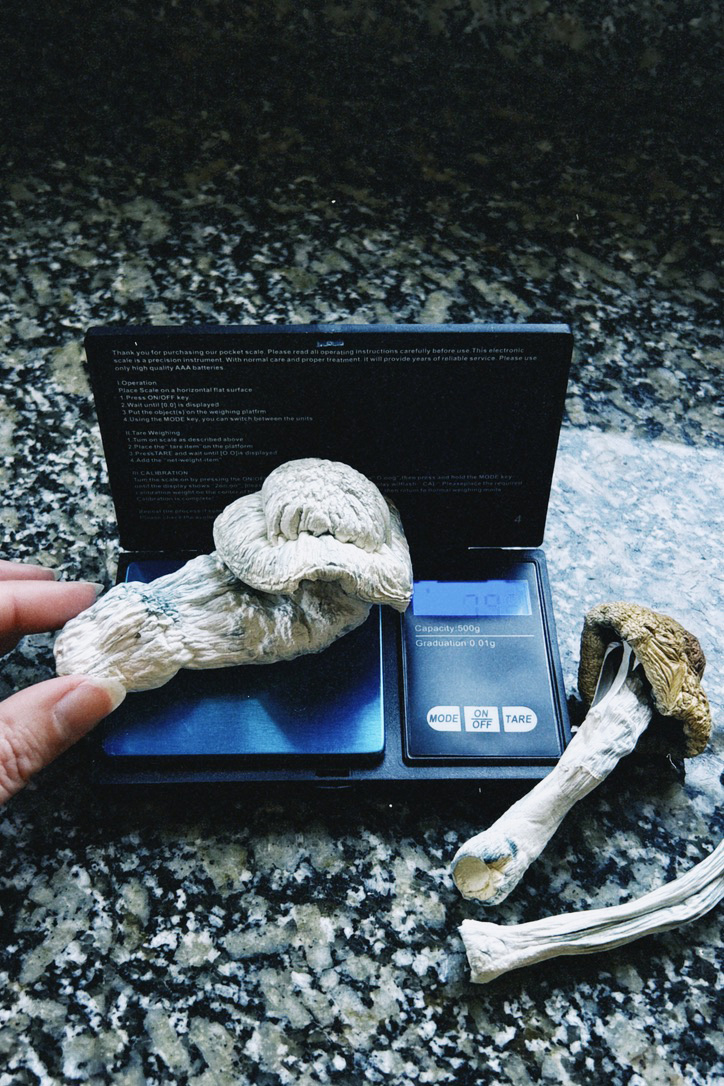
Weigh it. Every time. Eyeballing a dose is not a good idea. Dried mushrooms are mostly air. Two caps that look the same in your palm can differ dramatically.
We recommend using a scale, so you know what you are taking.
Ideally you want a scale that is accurate to 0.01 g. Most kitchen scales will work, but only read to 0.1g.
We sell a precision scale for $25.
Write the number down. You’ll want to be able to know what you took. For any future experience, you’ll be able to decide if you want to go up or down.
All at onceTaking it in one go, or splitting the dose
Taking the whole amount in one go gives you a single clean arc: one come-up, one peak, one return. Splitting the dose usually extends the experience, but it doesn’t heighten the peak. Once you’ve done a few journies, you can explore this, but your first experince, we recommend completing the full journey as it is.
The classic mistake
Do not top up at thirty or forty‑five minutes because it does not feel like it is working. It is working. It has not arrived. This is the single most common way people end up much further out than they meant to go, because both doses then land together.
Tolerance builds within hours. A second dose taken ninety minutes in does noticeably less than the same amount would have done at the start.
The come‑up is the unpleasant part. Taking two of them means doing the worst bit twice.
The arc goes muddy. A journey with a clear beginning, middle and end is far easier to make sense of afterwards than a long flat afternoon that never quite resolves.
If you genuinely do not know your own sensitivity and you want a floor under you, take the lower amount, wait the full ninety minutes, and go in knowing that topping up buys you a longer plateau rather than a deeper journey. That is a reasonable trade for a first time. It is not a way to reach a bigger dose by instalments.
Felt nothingIf you took it and nothing happened
It happens, and there are only a handful of explanations. Work through them in order, and do not take anything else while you are still working through them.
- It has not arrived yet. Dried mushrooms on an empty stomach take 30 to 60 minutes, sometimes 90. Food pushes that out further. Almost every “nothing is happening” moment lands around the 40‑minute mark, which is exactly the wrong time to judge it.
- The dose was smaller than you think. If you did not weigh it, you do not know what you took. And potency varies by a factor of three or more between one mushroom and another.
- The mushrooms are old or badly stored. Psilocybin degrades with light, heat, oxygen and moisture. A bag kept in a warm, bright kitchen for a year has lost a real part of what it had.
- Tolerance. If you journeyed in the last one to two weeks, the same dose does much less. Within a few days it can do almost nothing.
- Medication. Long‑term SSRI use blunts the effect for a lot of people, sometimes substantially. Chapter 13 goes into that properly.
- Some days are just lighter. Same person, same dose, same jar, different week. Nobody has a good explanation. Sleep, mood and where you are in your life all seem to matter.
What not to do
Do not take more at forty‑five minutes. Do not take more a second time. If you reach the two‑hour mark and there is genuinely nothing at all, not softened colour, not a lift in mood, nothing, then you have a real non‑response. The honest answer is to stop for the day and try again in two weeks with a weighed dose from a different batch. Redosing into uncertainty is how people end up far further out than they planned.
Is there more psilocybin in the caps or the stems?Where it sits in the mushroom
Caps do average higher, slightly. However, it reverses in some strains. There is more variation in other areas such as mushroom to mushroom, batch to batch. In other words, sorting the caps out to get a stronger dose is turning the quietest dial on the board.
Tsujikawa and colleagues, 2003. A Japanese forensic team ran HPLC on Psilocybe cubensis taken off the market there. By dry weight, caps held 0.44 to 1.35% psilocybin and psilocin combined. Stems held 0.05 to 1.27%. Compare the top of each range and they nearly meet. Compare the bottom and they do not: the weakest stem was close to empty, the weakest cap was not. source
Gotvaldová and colleagues, 2021. The only group to separate caps from stipes and then run the statistics. Caps came in at 1.03% total tryptamine alkaloids by dry weight against 0.52% for stipes, and psilocybin alone at 0.88% against 0.47%. Psilocin, the already converted form, looked far more lopsided at 85% less in the stems, and that is the comparison they tested: p = 0.38, which is not significant. One mushroom differed from the next by more than caps differed from stems. source
Bigwood and Beug, 1982. Two strains, two different answers. In the first, caps carried roughly twice the psilocybin of the stems, but the whole of the small amount of psilocin sat in the stems. In the second, caps and stems held equal psilocybin. The same paper watched alkaloid levels swing by more than a factor of four across successive flushes of the same genetics in the same room. source
Orange Photonics, 2024. An instrument maker put two strains through a LightLab analyser and found the rule flips. Golden Emperor caps beat their stems. Penis Envy stems beat their caps. Two samples on a company blog is not a study, but it points the same way the 1982 paper did: the strain decides more than the part does. source
A 2025 review in Pharmaceuticals gets quoted as a second study finding caps stronger. It reaches that conclusion fairly, but its numbers are the 2003 Japanese dataset, so it is the same evidence counted twice. source
Potency testingHow you would get a real number, and why it still would not be exact
There is a way to know exactly how much psilocybin is in a mushroom: high‑performance liquid chromatography, or HPLC. A lab grinds a sample, dissolves it, pushes it through a column and reports psilocybin and psilocin as a percentage of dry weight. Mass spectrometry is the more sensitive version of the same idea.
Unfortunately these tests are quite expensive, often costing more than the entire batch of mushrooms. Plus, they only tell you about that sample. Potency varies between flushes and between two mushrooms grown side by side. So even a real lab number is an estimate of an average. In Canada, this equipment is usually in a lab that isn’t open to testing mushrooms as they aren’t fully legal.
At home testing kits
Reagent spot tests, usually Ehrlich’s, turn purple in the presence of indole compounds. That tells you something indolic is there, which is a reasonable confirmation that what you are holding is a psilocybin mushroom and not a lookalike.
What it cannot do is quantify. It will not tell you whether you are holding 0.4% or 1.6%, and it does not cleanly distinguish psilocybin from other indole alkaloids. It answers “is this what I think it is”, not “how strong is it”. For the second question there is no shortcut that works at home.
Our shopWhat the dots on our product pages mean ⚫⚫⚪
Every mushroom we sell carries a three dot rating. It is a comparison of dose strength between our own products, drawn from how they land for us and from what the people who buy them tell us.
It is not a lab measurement and it is not a scientific scale. Three dots on one mushroom and three on another means we expect them to land in a similar place, not that they contain the same amount of psilocybin. Nobody can tell you that without sending a sample to a lab.
Use the dots to choose which mushroom. Use the scale to decide h
Synthetic psilocybin and dried mushrooms
Almost every clinical trial you have read about used synthetic psilocybin: a single purified molecule. In these trials they need to measure what one substance does, which means means holding everything else still. That is a fact about trial design, not a verdict on mushrooms.
There nowhere in Canada to access synthetic psilocybin outside of a clinical trial, so this isn’t likely going to impact you practically.
Side by side Comparing synthetic to dried mushrooms.
A synthetic capsule gives every participant in every session a exact dose, often 25 milligrams. A mushroom is a natural product cannot promise that exact dose, and the gap between those two facts is most of what makes dosing an estimate rather than a measurement.
In the trials
Synthetic psilocybin
- One purified molecule and nothing else.
- The same dose every time, batch after batch.
- Decades of regulatory familiarity, which is what let the first trials happen at all.
- Expensive to make, and not what is available in Canada.
In your hand
Dried mushroom
- The whole fruiting body: psilocybin, psilocin and a handful of related alkaloids.
- Natural Potency varies between strains, between flushes, and between two mushrooms from the same tub.
- What people have actually been taking for as long as there are records of it.
- You dose by weight, which means you dose with a margin.
Dose mathRough equivalence: trial doses, in grams of mushroom
Clinical trials dose synthetic psilocybin in milligrams. You are dosing a mushroom in grams. This is the translation, and the width of it is the point.
On the left, a dose of synthetic psilocybin in milligrams. On the right, the dried mushroom it works out to across the normal potency range, roughly 0.5% to 1.5% by dry weight. 25 mg is the dose used in the large depression trials. Depending on potency, that same 25 mg is anywhere between 1.7 g and 5 g of mushroom. That spread is the whole reason we tell you to start lower than you think.
What is in a mushroom?
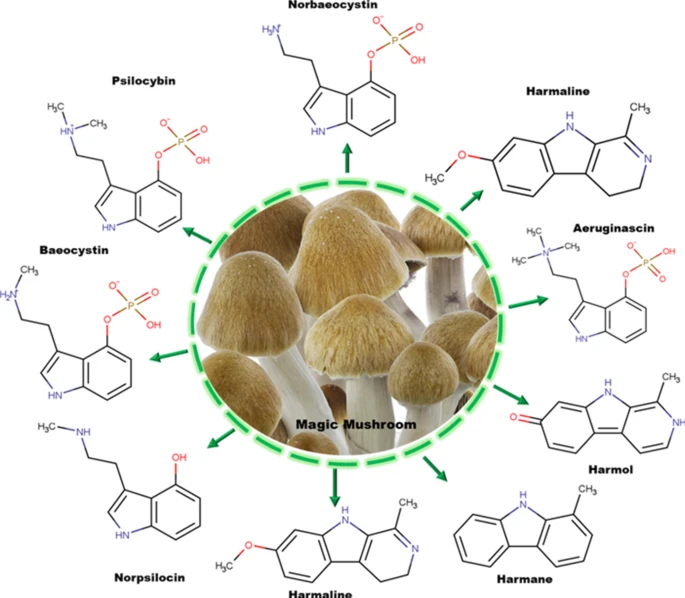
The primary active ingredients in magic mushrooms are naturally occurring psychoactive compounds belonging to a class of chemicals called tryptamines.
The main compound we are interested in is psilocybin. We will explore the science of how this works in a later chapter.
Within minutes of swallowing it, your gut and liver turn it into psilocin, and psilocin is the compound responsible for everything you feel.
Psilocybin is the more stable of the two, which is why dried mushrooms keep at all, and why bruised ones go blue. That blue is psilocin oxidising where the tissue was damaged.
By weight, psilocybin makes up somewhere between .5%-1% of a mushroom. The rest is made up on the fungal structure, proteins, carbohydrates, and chitin.
Mushrooms don’t just contain one single molecule either. It is a family of related compounds, but they are present in far smaller amounts, and far less is known about any of them. Other compounds such as baeocystin, norbaeocystin, aeruginascin, and β-carbolines may modulate effects.
Plenty of people believe the other compounds shape the character of a journey, and that they are why one strain feels more visual and another feels gentler or more therapeutic. They might. The idea has a name, the entourage effect, and the honest position is that it has barely been studied. Everything we know about them comes from dishes, mice and computer models.
We’ve detailed these below if you’re interested.
Baeocystin and norbaeocystinDishes and mice so far
That baeocystin is a real contributor to the character of a journey, and that strains higher in it land differently.
Baeocystin is psilocybin with one methyl group missing. It converts to norpsilocin, and in a dish norpsilocin turns out to be roughly as potent as psilocin at the same receptor. That is a striking result and it is why people got excited.
Then in mice it produced no psychedelic response at all, at any dose, most likely because it never reaches the brain. Norbaeocystin is two methyl groups short and did nothing on that measure either, although one study found it reduced a depression‑like behaviour in rodents.
A compound that is powerful at the receptor but cannot get to it is a delivery problem, not a dead end, and solving delivery problems is most of what medicinal chemistry does. It is why a few labs are still working on these.
AeruginascinA genuine open question
That this is the compound responsible for the euphoria, and the reason a mushroom feels warmer and friendlier than synthetic psilocybin.
Less than you would hope. It carries a permanent positive charge, which makes it unlikely to cross into the brain. It did nothing in mice. It is present at roughly a fiftieth the level of psilocybin. And the euphoria story traces back to uncontrolled reports of accidental poisonings with a different mushroom entirely, Inocybe aeruginascens, where people described the experience as unusually pleasant.
The original observation was real. People genuinely did report something unusual. What has never been done is the experiment that would explain it, and “not evidenced” is a different thing from “disproven”. This one sits firmly in the first category. If you repeat the aeruginascin story you are repeating an untested hypothesis from the 1980s, which is fine as long as you know that is what it is.
Beta‑carbolinesA real find, at the wrong scale
That mushrooms contain their own MAO inhibitor, which potentiates and extends the experience from the inside.
Harmane, harmine and norharmane are confirmed present in Psilocybe, and finding them there was a genuinely interesting discovery: the fungus makes both a psychedelic and compounds that could in principle slow its breakdown.
Then you look at the amounts. A full dose delivers a few micrograms. An active MAOI dose is tens of milligrams, somewhere around ten thousand times more. Whatever is happening in your afternoon, this is not it.
The good question here is not about your dose, it is about the fungus. Why does Psilocybe make these at all? Nobody knows. A mushroom that produces a psychedelic alongside the compounds that would protect it is a real biological puzzle, even though it changes nothing about what you will feel.
Beta‑glucans and the rest of the fungusGood compounds, wrong vehicle
That mushrooms are good for your immune system, and psilocybin mushrooms are mushrooms, so a journey dose must be doing something for you beyond the journey.
The beta‑glucan literature is substantial and real, mostly around immune modulation and cholesterol. These are properly interesting compounds and the research is not in doubt.
The catch is arithmetic. Studied doses run around three and a half grams a day for eight weeks, and the authorised cholesterol claims come from oat and barley rather than mushrooms anyway. A two to five gram dried dose supplies maybe a fifth of a gram to a gram and a quarter of beta‑glucan, once. Nobody has even measured the beta‑glucan content of Psilocybe cubensis specifically, so that figure is extrapolated from other species.
Same story for ergosterol, the vitamin D precursor. Mushrooms only develop meaningful vitamin D2 after ultraviolet exposure, and psilocybin mushrooms are dried in the dark.
Everything here is real except the dose. Your journey is simply the wrong vehicle for it. If you want the beta‑glucans, eat a mushroom with dinner, and that is not a brush‑off, it is the actual answer.
PhenethylamineOne paper, wrong species
That phenethylamine is what causes the body load: the racing heart, the heaviness and the anxiety in the first hour, and that some strains carry more of it than others.
The whole claim traces back to a single paper, published in the Journal of Analytical Toxicology in 1998. It measured phenethylamine in Psilocybe semilanceata, the liberty cap, not cubensis, after three men were hospitalised with racing hearts. The authors raised it as a possible explanation and said so plainly: a hypothesis, not a finding.
No study has ever measured phenethylamine in Psilocybe cubensis at all. Not once. So the claim is unsupported for the mushroom you are almost certainly holding, and rests on one paper about a different species.
It is a clean example of how a hypothesis about one species, in one paper, from the 1990s, becomes a confident fact about a different species twenty‑five years later. Nobody lied. Each retelling just dropped a qualifier.
If you take one habit from this section, make it the habit of asking which mushroom was that actually about. And for the practical question: the body load is real and you will probably feel it. Chitin and the serotonin receptors in your gut explain it perfectly well, without needing this compound at all. Chapter 07 covers what to do about it.
So does the rest of the mushroom do anything?All of them together
That a whole mushroom provides a better, fuller experience than synthetic psilocybin, because the minor compounds work on each other and produce something the isolated molecule cannot. The idea is called the entourage effect.
Ryan Moss is chief science officer at Filament Health, which grows Psilocybe cubensis and extracts the psilocybin together with the other alkaloids. He accepts that psilocybin is doing most of the work, and then adds that there are “compounds in there that can probably aid or modulate the experience.”
If the effect is real, it might be engineered into better psilocybin medicines: more visuals, or a longer or more intense session where that would help the treatment. For now that is a hope rather than a result.
Start with the gap. Nobody has ever studied whole mushroom against synthetic psilocybin. The one real experiment is a 2024 mouse study led by Bernard Lerer. Whole‑mushroom extract and dose‑matched synthetic psilocybin produced similar acute effects. Afterwards, the extract group showed a larger metabolic response and more synaptic protein production. However, the difference in synaptic markers was not statistically significant. A second study found the extract reduced anxiety‑like behaviour in mice more than synthetic psilocybin did, and it has been criticised over its methods and analysis.
Computer modelling has suggested some of the minor compounds could be doing something, by predicting how they behave at the receptor. The fullest version of that work is a February 2026 paper in Scientific Reports that puts “entourage effect mechanisms” in its title. It screened fifteen mushroom compounds, kept the eight it predicted would reach the brain, and simulated them docking into serotonin receptors and the enzymes that break monoamines down. All eight anchored to the same receptor residue that serotonin itself uses.
Nothing in that study touched a cell, an animal or a person, and its authors close by saying the predictions still need laboratory validation. Its one concrete mechanism, that the beta‑carbolines could inhibit MAO‑A and stretch the experience out, is the claim worked through in the beta‑carbolines pop‑out above, where the amounts turn out to be roughly ten thousand times too small to do it. Worth knowing, and worth holding loosely: modelling produces a hypothesis about what might happen, not a measurement of what did. It tells you where to point the next experiment.
And the case against. The four compounds above are present in tiny amounts, and most of them appear not to reach the brain at all. If the entourage effect is real, the mechanism is not simply “more active compounds”, because on current evidence they are not active. It would have to be something subtler, which is harder to demonstrate and easier to assert.
It is also worth knowing that the entourage effect in cannabis, where the phrase comes from, is itself contested and largely unproven in humans. Borrowing a term does not borrow evidence with it.
Because it is a genuinely open question being actively researched, and because of how neatly the two sides line up. The mushroom is the thing people have always taken. The capsule is the thing that has been tested. Neither of those facts is evidence about the other, and nobody should pretend otherwise.
Anyone who tells you the mushroom is definitively better is ahead of the evidence, and that includes us. What we can say is that the mushroom is what this guide is written for.
There is a whole set of people for whom this entire discussion misses the point, and they are worth hearing out.
Plenty of those who swear by whole mushrooms are not making a chemistry argument at all. They will tell you they have a relationship with the mushroom. Not as a figure of speech: a relationship, built over years, with something they treat as having its own character and its own intentions. They greet it before they take it. They ask, and sometimes the answer is no. They thank it afterwards. Some grow their own so that the lineage is theirs and the relationship has a history, keep spores back from each flush, and would no more swap that for a standardised capsule than you would swap a friend for a transcript of a conversation with them.
This is not something invented on the internet. In the traditions this practice came from it is simply the ordinary form. María Sabina sang to the mushrooms, called them los niños santos, the holy children, and spoke of them as the ones doing the talking. Translating that into a lab result is its own kind of error.
From inside that view, the question we’re trying to answer, is irrelevent. In this framework, it doesn’t matter than baeocystin modulates a receptor. A living thing you have built a relationship with is not things as chemical made in lab..
We will add one observation that costs nobody anything. Greeting the mushroom, setting an intention, asking and thanking, growing the thing yourself, treating the day as an occasion: all of that is set and setting, which is the one variable that demonstrably shapes how a journey goes. So the practice may be doing real and measurable work even where the mechanism is not the one being claimed for it. Whether the relationship is with the mushroom or with your own attention is not a question anyone can settle from outside, and both answers leave it worth doing.
Where all of this comes fromSources
Everything in this section traces back to these.
Alkaloid levels from Gotvaldová et al., International Journal of Molecular Sciences, 2022. Receptor work on the minor compounds from Sherwood et al., Journal of Natural Products, 2020. Phenethylamine measurement from Beck et al., Journal of Analytical Toxicology 22(1), 1998. Entourage reporting, and the quotes from Moss, Lerer, Roth and Sherwood, from Johnson-Groh M, “Is There More to Magic Mushrooms than Psilocybin?”, ACS Central Science 2025;11(8):1256–1260, available here.
06
Choosing a strain
Almost every strain on the market is the same species of mushroom, Psilocybe cubensis. There are different strains within that species. Golden Teacher, Mazatapec, B+ and the rest are like apple varieties: still apples, with a different character. Here is what matters when you choose.
Our longer take is in What Strain Should I Choose?
Potency is real
Some strains are reliably stronger. Penis Envy lineage strains like Penis Envy and Albino Penis Envy, and Enigma strains like Nimbus Clouds Enigma, run roughly .5 to 2 times stronger than Golden Teacher. In other words, even though they weigh the same, certain strains will contain more psilocybin. If you are trying a new, more potent strain for the first time, take a smaller dose.
What two grams actually means
Both are two grams on the scale. The solid bars are the same length because the weight is the same. The hatched section is the difference the strain makes: the same two grams of a potent variety behaves like three to four grams of Golden Teacher.
Character has not been studied
Descriptions like “visual”, “euphoric” or “introspective” come from community reports and grower lore. That does not make them wrong. It means nobody has tested them: no one has ever compared matched doses of two cubensis strains in a controlled study, so there is no evidence either way. If strains do have distinct characters, we would not currently be able to tell. What we can say is that your dose, your mindset and your setting shape the day far more than the name on the bag.
For a first full journey
Choose a well-known, moderate strain like Golden Teacher and get to know it. Staying with the same strain between journeys also makes it much easier to adjust your dose with confidence.
A few are a different species
Some varieties, like Psilocybe natalensis, are not cubensis at all. They can feel different and dose differently, so read the product notes before you start.
What to avoid:
Mushrooms sold loose with no species named. Product described only as shrooms. Crumbled fragments you cannot recognise as caps and stems. Any smell of must or damp, which means moisture, which means both lost potency and possible mould. Dosing advice that starts high. And anyone who will not give you a straight answer about where it came from.
ForagingPicking your own, and the mushroom that kills people
We will be blunt. Do not forage for your first journey, or your tenth, unless someone who knows what they are doing has taught you in person and you have keyed out specimens alongside them more than once.
Psilocybe species are small, brown and unremarkable, and they share that description with several genera that are not forgiving. The one to know about is Galerina marginata, the funeral bell. It grows in the same decaying wood and wood‑chip habitats, it is superficially similar to an untrained eye, and it contains amatoxins, the same class of compound as the death cap. Amatoxin poisoning destroys the liver. Symptoms are delayed by six to twenty‑four hours, so by the time you feel ill the damage is already underway, and there is no home test that will warn you.
Blue bruising is a clue, not a confirmation. Several mushrooms without psilocybin also bruise blue, and some that do have it bruise only faintly. A reagent spot test tells you indoles are present. It does not identify the species and it will not catch a toxic lookalike picked from the same patch.
If you do forage, go with a mycologist, take spore prints, learn the lookalikes before you learn the targets, and never eat anything on the strength of a photo match from an app or a forum.
A common mix‑upAmanita muscaria is not a magic mushroom
The red mushroom with white spots, the one from every storybook, contains no psilocybin. Its active compounds are muscimol and ibotenic acid, which work on the GABA system rather than on serotonin. That is a different mechanism, and it produces a different day: more sedation and delirium, far more nausea, dosing that is genuinely hard to predict, and a real toxicity risk if the mushroom has not been prepared properly.
It has its own long traditions and its own advocates, and none of that is our argument. The point is narrower. If you came to this page looking for information about Amanita, almost nothing in this guide applies to it, including every dose, every timing and every piece of advice about what the hours will feel like.
Drug checkingCould mushrooms be laced? Almost certainly not, and here is why
While we understand the concern, whole dried mushrooms are essentially never adulterated.
The clearest argument is economic. Psilocybin mushrooms are cheap and easy to grow. Adding anything to them costs money, adds legal risk and makes the product worse. There is no market for lacing a substance nobody is cutting in the first place. Fentanyl contaminates powders and pressed pills, where tiny amounts are the whole product. A dried mushroom is not a powder.
Whole dried mushrooms are also the format you can actually inspect. You can see the cap, the stem, the colour, the bruising. That is a real safety feature, and it is a reason to prefer them for a first journey.
The real risk is in unlabelled edibles. In 2024 the US outbreak linked to Diamond Shruumz chocolate bars, cones and gummies ran into serious health risks. The FDA found muscimol, psilocin, 4‑acetylpsilocin, kavalactones and pregabalin, a prescription drug, in various products. People bought something labelled as a mushroom edible and got a mixture nobody had disclosed.
So the rule is not “test everything”. It is know what you are eating and who made it. With chocolate, tea or gummies, that means a maker who states the species, the dose per piece and nothing else in it. If a bar will not tell you what is in it or how much, do not take a chance on it, whoever is selling it.
On test strips. Fentanyl strips are cheap and widely available in Canada through harm reduction services. They test for fentanyl only, they need the sample properly dissolved in water to mean anything, and a negative result is not a certificate of purity. We do not think you need one for dried mushrooms from a source you trust. If that fear is what is keeping you awake, use one anyway: it costs almost nothing and peace of mind on the morning of a journey is worth more than being right about the statistics.
Reagent kits are a different tool and answer a different question. They confirm indoles are present, which supports “this is a psilocybin mushroom”. They cannot tell you how strong it is and they cannot catch a toxic lookalike. Chapter 06 has more on that.
07
How to take mushrooms
There is no single right way. The method changes how quickly it comes on, how your stomach feels and, a little, how long it lasts. It does not change what the medicine is. Here are the options, starting with the traditional one.
Dried mushrooms, the traditional way
Eating the dried mushroom is the oldest and most common way, and it is still how most people do it. Weigh your dose on a scale that reads to 0.1 g, then chew it slowly and thoroughly before swallowing, or grind it and stir it into yogurt, applesauce or a smoothie if you do not like the taste. Effects usually begin in 30 to 60 minutes. Some people do find they experience nausea or cramping. We detail why this happens in the section below. Ginger can help, and so do the methods below. Shop dried mushrooms.
Chocolate
We make chocolate bars, and for a lot of people they are the easiest way in. The dose is measured and divided for you, so you are not weighing anything, and chocolate is far kinder to the stomach than chewing dried caps. It also tastes like chocolate!
Check the dosing printed on the label you have and work out your amount from that before you start. Be careful, sometimes the chocolate tastes so good you’ll want to keep munching! Chocolate tends to come on gently, usually within 30 to 60 minutes.
Tea
Tea is gentle on the stomach and often comes on a little faster, somewhere around 20 to 40 minutes, because you are drinking an extract rather than digesting a mushroom. Some people find the same weight feels a touch softer this way.
Our Journey Teas are pre‑portioned. Check the dosing on the packet and work out how many bags your dose comes to before you begin. Steep in hot water for 10 to 15 minutes, pressing the bags a few times, and drink the whole cup.
Making your own. Grind your dried mushrooms as finely as you can first. A blade coffee grinder is ideal, a food processor works, and a mortar and pestle works. The finer the powder, the more you actually extract. Add it to a mug of hot water, but not boiling, to protect the psilocybin. Steep for 10 to 15 minutes, stirring now and then, then strain out the pieces. Ginger, lemon or a little honey all help, and the ginger does double duty against nausea.
If you strain it, some of the dose stays behind in the material you throw away. If you would rather not lose any, drink the grounds along with the tea, or run a second short steep on the same powder and drink that too.
Lemon tekA faster, sharper way to drink it
Lemon tek means soaking ground mushrooms in fresh lemon or lime juice for 15 to 20 minutes before you take them. The acid is thought to start breaking the mushroom down before it reaches your stomach. People report that it comes on faster, often in 15 to 30 minutes, feels more intense, and is shorter overall. This comes from experience reports rather than clinical research, so treat it with respect: many people take a quarter to a third less than their usual dose, and it is not the best choice for a first journey. Strain it, and add the juice to a cup of tea if it is too sour.
Whatever you choose, take the full amount within a few minutes and note the time. Do not take more because it seems slow to start, whole mushrooms can take an hour.
Nausea - how to have less of it
Some nausea in the first hour is normal, and most of it is not the psilocybin acting on your mind. Two things are going on.
Chitin is the tough fibrous material mushroom cell walls are built from, and human stomachs are not equipped to break it down. That is the bulk of it, and it is also the strategy: anything that reduces the amount of raw mushroom sitting in your stomach reduces the nausea.
Your gut has serotonin receptors too. Most of the serotonin in your body is in your digestive tract, not your brain, and psilocin acts there as well. That is why nausea tracks the come‑up and tends to lift as you arrive, and it is why straining the solids out helps but does not always remove it entirely.
Six things that helpHow to have less of it
- Do not eat for about four hours beforehand. Less in your stomach means less to be sick with, a faster onset and a cleaner come‑up. It is why most people take their dose first thing in the morning. .
- Pick a form that leaves the mushroom behind. Tea and lemon tek both strain out the solids, so you drink the psilocybin without the material that causes the trouble. Chocolate is gentler than chewing dried caps.
- Grind it finely if you are eating it whole. Powder is easier on your stomach than chunks and absorbs more evenly, which also makes the come‑up less abrupt.
- Have ginger. Ginger tea in the half hour before, and more during the come‑up. Candied ginger or capsules work too. This is the single thing people report helping most.
- Stay upright for the first hour. Lying flat through the come‑up makes nausea worse for most people. Sit, or walk slowly, and breathe low and steady.
- Put a bowl and a glass of water within reach. Before you start, not during. Knowing it is there takes the edge off, and the edge is most of it.
If you are sickWhat it means, and what not to do
It almost always happens once, during the come‑up, and most people feel better immediately afterwards. If it happens more than about forty minutes in, you have already absorbed most of the dose. Do not take more to make up for it.
The vagus nerveHow gut serotonin turns into a feeling
That psilocybin causes nausea by switching on 5‑HT3 receptors on the vagus nerve, the same receptors chemotherapy drugs set off.
The vagus really is the wire. Nausea in general works like this: something irritates the gut, cells in the gut lining release serotonin, that serotonin lands on 5‑HT3 receptors sitting on vagal nerve endings, and the signal runs up the vagus to the brainstem. It is why ondansetron, which blocks 5‑HT3, is the standard drug for chemotherapy nausea.
What does not hold up is psilocin pulling that particular trigger. Measured against the 5‑HT3 receptor, psilocin binds more weakly than 10,000 nM, which in practice means it does not bind at all. Against 5‑HT2B it binds at 4.6 nM, and against 5‑HT2A at around 107 nM, and both of those are plentiful in the gut wall. So the likely route is one step removed: psilocin acts on the 5‑HT2 receptors in your gut, that disturbs motility and local serotonin release, and the serotonin is what reaches the vagal endings. The vagus carries the message. Psilocin is not the thing knocking on that door.
Tested any of this for psilocybin. The one paper to take the gut seriously is an opinion piece from Monash in 2024, and even there the vagus argument is about whether gut signalling helps produce the antidepressant effect, not about the nausea. Its authors say plainly that no study has yet investigated psilocybin’s actions outside the brain, and they propose cutting the vagus in animals as the experiment that would settle it. Nobody has run it.
Reed & Foldi, Trends in Pharmacological Sciences, 2024 · Browning, Frontiers in Neuroscience, 2015 · PDSP Ki database, psilocin binding
It usually passes. For almost everyone it is gone by the time the experience properly begins, and a lot of people find the moment it lifts is the moment the journey starts.
08
The day itself
Every journey is different, and so much depends on the dose, the method and the person. Treat this as a rough map of what can happen, not a schedule of what will. Your sitter should read it too.
Plan for the whole day, not for six hours. Then an afterglow that can run for a day or two past the end of this chart.
Hour zero
Take it in the morning or early afternoon so you are not trying to sleep while still feeling the effects. Take it with intention, however you understand that. Then put on the music, lie down, and wait.
Thirty to sixty minutes
The first changes. Most people notice the room looking slightly more alive before anything else: edges a little sharper, colours a little louder, the light doing something it was not doing before. Honestly, this phase can feel uncomfortable for a few reasons. Often a wave of slight nausea, a heaviness in the limbs or a strange lightness, a yawn you cannot explain. Some people get cold or shivery. A nervous, fluttery feeling here is completely normal and is not a sign of anything.
This is a good stretch to meditate, even if you never meditate. Sit or lie down, close your eyes, and put your attention on your breath. You are not trying to achieve anything. The point is to be present for the arrival instead of watching the clock and checking whether it is working yet, which is what turns ordinary nerves into anxiety. Twenty or thirty minutes of that and the come-up tends to land much more gently. If silence feels like too much, quiet instrumental music does the same job.
One to three hours
The peak. This is the part nobody can fully describe to you. You may experience visual patterns with your eyes open and entire worlds with them closed. Emotion may come in waves. Time can move strangely. You may feel the usual boundary between you and everything else become thin or disappear. Memories, insights, laughter, beauty, sometimes dread. All of it is the medicine working.
If it gets hard
If you feel frightened, the best advice is “trust, let go, be open.” It can help to remember these things in this order. You took mushrooms. This is temporary and it will pass. You are physically safe. Your sitter is in the room. Breathe out slowly. Then go with the flow. Do not run from what is showing up; turn toward it, get curious about it, and let it move through you. Fighting the experience is what makes it harder. If a thought or image is overwhelming, you can change the music, open your eyes, sit up, or move. But if you can, stay with it a little longer than feels comfortable, because what is on the other side of the hard part is usually the thing you came for.
Three to five hours
The descent. The intensity softens and you begin to come back. This is often the most emotionally open part of the day, when things make sense in a way they will not quite the next morning. Many people want to talk now. Many want to cry. Both are good.
Five to seven hours
Back, more or less. Tired, tender, hungry. Eat. Drink water. Do not make any decisions. Do not text anyone. Write a few things down if you can, even fragments.
That night
Sleep may be light. That is fine. Tomorrow is when the real thinking starts. You may also experince ‘afterglow’. This is the the positive mental, emotional, and physical effects that linger in the hours, days, or even weeks after the acute effects of a psilocybin (magic mushroom) experience have worn off.
Bad trips, honestly
A few different things get called a ‘bad trip’, adverse reactions include anxiety, panic, depersonalization, ego dissolution, paranoia, as well as physiological symptoms such as dizziness and heart palpitations. However, most studies indicate that the set and setting of substance use influence how people respond.
A hard few hours is common.
Grief, paranoia, the certainty that you have broken something permanently, a stretch where you cannot tell whether an hour or a week has gone by. At the higher doses a meaningful minority of people meet some version of this, even in a supervised room with a trained guide. Researchers call them challenging experiences rather than bad trips, and the distinction is not spin: the label describes the hours, not the outcome.
Most people who go through one do not look back on it as a bad trip. They look back on it as the hard part, and often as the part that mattered. People often describe these challenging experiences as what taught them the most. They may have not been able to solve the challenge in the moment, but in the months afterward. This is what integration is about. Taking meaningful action on the things you experienced.
If you are reading this with a psychiatric history, you should really work with a trained therapist or guide.
So how do you avoid one? You cannot guarantee an easy journey. Your set and setting will have the biggest impact, followed by your ability to manage the challenging experience during the journey. More advice below:
The leversHow to avoid a challenging experience
Prospective research keeps finding the same thing: preparation, intention and environment predict both how hard a session gets and how much good comes out of it.
- Take less than you think you want. The single biggest lever is dose. If you dose too high on your first experince, you won't be famililar with the feelings, and they might feel overwhelming. You can always go further another day.
- Have one sober person in the room. It changes both how likely a spiral is and how long one lasts. The research on difficulties that persisted for months found they were worse and longer when the session had been unguided.
- Prepare the week, not just the day. Going in exhausted, newly bereaved, mid‑crisis or trying to outrun something you have not named stacks the deck before you swallow anything. Chapter 03 is the honest checklist.
- Decide everything in advance. Where, who, what music, what you will eat, what time it ends, what happens if someone wants to leave. Open questions turn into arguments at hour two, and arguments at hour two are enormous.
- Write an intention you could say out loud. Then hold it loosely. A direction steadies you when things get strange. A demand becomes one more thing to fail at.
- Do not mix anything in. No cannabis at the peak, no alcohol, no stimulants, no caffeine that morning. Every addition is a variable you cannot remove once it is in you.
- Empty stomach, morning start. Four to six hours without food, dosed between nine and eleven. A cleaner come‑up and daylight for the whole thing.
- Agree the one rule beforehand. When something frightening arrives, turn toward it rather than running. Fighting the experience is what makes it hard. This is much easier to do if you decided it while sober.
If it turns hardWhat to do in the moment, and where that advice comes from
Most of the advice you will hear for a hard passage is a version of the same instruction, and it has a real lineage.
The Johns Hopkins safety guidelines, which shaped how modern trials are run, put it plainly: “the best way to deal with all such situations is to surrender to the experience.” On frightening imagery specifically, they tell guides that the participant should be encouraged to mentally approach the figure and interact with it, rather than attempt to flee from it. Talking someone down, they note, tends to make it worse.
Bill Richards, who has guided more of these sessions than almost anyone alive, gives people a shorter version: “trust, let go, be open.” It is worth memorising, because three words are about all you can hold onto at the time.
The oldest version in the Western literature is from Leary, Metzner and Alpert in 1964: “whenever in doubt, turn off your mind, relax, float downstream.” John Lennon lifted that line for Tomorrow Never Knows, which is why it sounds familiar.
And the phrase that does the most work, from the MDMA therapy manual but true here too: moving through something is how you heal it, rather than moving away from it. “Go with the flow” is the folk version of all of these, and it is good advice, as long as you understand that flowing toward the difficult thing is what is meant.
The thing that actually ends a spiral
Say it out loud, to the person in the room. “I am frightened.” “I think I am stuck.” Almost nothing collapses a spiral as reliably as naming it to another human being, because a spiral depends on you being the only one inside it.
Which is also why you tell your sitter, in advance and while sober, that you might say exactly that, and that the right answer is not to fix it. It is to stay.
The other best tactic is to change up the enviroment. If you are inside, walk outside. If your in a crowded place, go somewhere more grounding. You can also change the music, if you are laying down, etc... These physical changes will likley lead to the mental and emotional change that will end the bad trip.
AfterwardsWhen a hard session becomes a reason to get help
Feeling tender, raw or unusually open for a few days is ordinary.
If things are feeling really hard or you can’t make sense of them, you should speak to a integration coach. This is a therapist or guide who can help you understand and integrate what happened.
If you are feeling really shaken up, such as:
- Distress that does not lift after several days
- Several nights where you cannot sleep
- Panic that does not respond to grounding, breath or company
- Not being able to function day to day
- Thoughts of harming yourself
- Hearing or seeing things when you are no longer under the effects
Any of these means it is time to speak to a doctor or a mental health professional. In Canada you can call or text 9‑8‑8, the Suicide Crisis Helpline, at any hour. You do not have to explain what you took to get help, though it is better care if you do.
Lasting harmWhat the largest review actually found
Lasting harm is rare. The largest review to date, published in JAMA Psychiatry in 2024, pooled 114 studies covering 3,504 participants. Among 1,726 healthy volunteers it found no serious adverse events at all. Among participants who came in with a pre‑existing psychiatric condition, it found serious adverse events in roughly 4%, with psilocybin specifically at 23 of 584 outpatients in the weeks after a session. Those events included worsening depression, suicidal behaviour and psychosis.
Read that carefully, because it says two things at once. In healthy, screened, supervised people the record is remarkably clean. In people with a psychiatric history, which is most of the people who come to mushrooms looking for help, the risk is real and it shows up after the session more often than during it.
Hinkle JT, Graziosi M, Nayak SM, Yaden DB. Adverse Events in Studies of Classic Psychedelics: A Systematic Review and Meta‑Analysis. JAMA Psychiatry 2024;81(12):1225–1235. Read it here.
Hallucinogen persisting perception disorderRare persistent visual changes
Mild visual drifting in the days after a journey is common and usually settles on its own. Hallucinogen persisting perception disorder, HPPD, is the clinical label for visual changes that stay. It is real, it is poorly characterised, and the estimates of how often it happens vary so widely that nobody should quote you a confident number.
What the literature does suggest is that it is associated far more with frequent heavy use than with one prepared session, and that distress about the symptom drives most of the harm. If visual changes are still with you weeks later, or they are frightening you, that is a reason to see a doctor rather than to read forums.
09
Why have a sitter or guide
Some experienced people journey alone. For a first full dose, or any time you are trying something new, we strongly suggest having someone with you. Here is why.
Preparation and intention
Deciding what you want from the day, out loud, with someone who will be there. Preparation and intention are among the few things research has shown to predict how a session goes.
Safety
Your coordination, judgement and sense of time all change. Someone sober can handle the door, the stairs, the bathroom and anything unexpected, so you do not have to.
Permission to let go
Knowing someone grounded is in the room makes it much easier to surrender to the experience instead of half watching yourself. That surrender is where much of the value is.
Support in the tough moments
A calm voice, a hand on your shoulder, or a change of music at the right time can turn a hard stretch into a meaningful one.
Someone to remember with
A person who was there can help you make sense of the day afterward and check in on you in the weeks that follow.
Making sense of it afterwards
The journey is only half of it. What you do with the material in the weeks afterwards is where most of the lasting change happens, and that part is much harder alone.
Let's define "Guide"
“Guide” is doing a lot of work as a word. It covers at least five quite different arrangements, and they are not interchangeable. What separates them is not skill, which varies enormously inside every category, but where their authority comes from and therefore who, if anyone, they answer to.
Licensed therapist
A regulator can take this away from them.
A psychologist, psychotherapist, counsellor or physician who has trained specifically in psychedelic work. Organisations like TheraPsil have been training clinicians for it for years. The biggest benefit here is that if something challening does come up, they are trained to support you during and after the journey.
What you get here and nowhere else: a complaints process, mandatory insurance, a defined scope of practice, and someone actually qualified to work with trauma rather than sit beside it.
Experienced underground guide
Often the most hours in the room, and no regulator.
Works outside the legal framework, frequently with many years and hundreds of sessions behind them. A lot of them are excellent, and some have more hands‑on experience than any licensed clinician in the country.
The part to be clear‑eyed about: there is no licence and no complaints process. There have been many cases of guides abusing their roles. Their accountability is whatever they have built for themselves, which usually means peer supervision, a mentor, or a community that would hear about it. Ask what theirs is. A good one answers without flinching.
Ceremonial facilitator
Accountable to a tradition rather than a board.
Works inside a tradition, Indigenous or otherwise, with its own training, its own protocol and its own idea of what the day is for. Where the lineage is real and the facilitator is genuinely accountable to it, this can be the deepest container there is.
Where it is borrowed, it is costume. Fair questions: who taught you, are you still in relationship with them, and what do you owe the community this practice came from?
Trip sitter
Someone you trust.
Ideally this is someone who has done their own mushroom jouries before. Perhapds have sat for other people before. They can rely on their experience rather than formal training. Little structure, but just the knowledge that someone is there, in the room with you counts for more than people expect.
The limits are honest ones. They are not trained to recognise a psychiatric or medical emergency. They may not be able to guide you through a difficult experience. That is exactly why chapter 10 exists, and why you should send it to them.
Finding someoneWhere people train, and how to read this list
In Canada, TheraPsil trains clinicians in psilocybin-assisted therapy and is the organisation behind the legal fight for practitioner access. Vancouver Island University runs a graduate certificate in psychedelic-assisted therapy, built on the Roots to Thrive programme. ATMA and Numinus run certification programmes. One honest caveat: no Canadian regulator licenses “psychedelic therapist” as a protected title, so these are certificates rather than licences. Look for someone who is a licensed therapist and has done this training, not one or the other.
We are not ranking these. Every one of them has produced extraordinary days, and every one has produced harm. But we will say plainly what most writing on this skirts: oversight genuinely differs. A licensed therapist can be reported and can lose their livelihood. An underground guide cannot. That does not make the guide worse, and plenty are better. It means the burden of checking falls on you, and you should actually do it.
How to Find a Psychedelic Guide walks you through choosing one, and our Support page lists guides across Canada.
Before you bookQuestions worth asking any of them
- What happens if I panic, dissociate, or want it to stop?
- Have you had a session go badly? What did you do?
- Who do you answer to, and what would someone do if they had a complaint about you?
- What is your training, and who trained you?
- Do you touch clients? Under what circumstances, and how do we agree that in advance?
- What happens in the weeks afterwards, and is it included?
- What would make you turn me away?
That last one is the test. Anyone who cannot describe a person they would decline to work with is either very new or not screening at all. And if they cannot tell you concretely what they do when someone panics or dissociates, that is a serious gap, not a style difference.
Should I journey alone, with one person, or in a group?
For some people, a guided solo journey is the best introduction to mushrooms. For many, they meet psychedelics for the first time with friends, and that can be the best introduction there is. Larger ceremonies are a beautiful path as well. Here the container matters more than the headcount. We’ve detailed these options below.
The different arrangementsWhich path to choose
On your own. If you journey alone, the experience becomes about you. It doesn’t get steered or derailed by someone else who might want to go for a walk or who is crying. The case for it is real: no social performance, nothing to manage, nobody to be polite to.
The case against is that if challenging things come up, you have manage these on your own. Another challenge is that you have no one who shared the experience with you. Its kind of like coming back from a vacation, telling your friend about the stunning hike you did. Which is nothing like actually going on a hike with that friend.
If you are set on doing it alone, at the very least tell someone what you are doing and when, keep them reachable by phone, and go lighter than you otherwise would.
Guided Alone. As we’ve talked about, there are huge advantages to having a guide.
Two or three people journeying together. It can be wonderful. For most people this is the introduction: a few friends, a house that feels safe, a camping trip in nature, a day cleared. There is nothing second rate about it. It can also turn into a social event you get to share and re-live when you tell stories about it afterwards. What you lose is the ability to go all the way inward, because some part of you stays on duty. What you gain is a shared reference afterwards, which turns out to matter more in integration than people expect. If you do it, agree in advance that anyone can go quiet, put headphones on or move to another room without it meaning anything, and have one sober person for the group rather than none.
Larger groups and ceremonies. A different format with its own logic, usually held by a facilitator, usually with music and structure carrying the room. The container is doing a lot of the work, so assess the container rather than the number of people.
It is also the oldest arrangement there is. Psilocybe mushrooms have been used ritually in Mesoamerica for roughly three thousand years. The sixteenth century Florentine Codex describes a Nahua ceremony where traders ate mushrooms together with honey, danced and wept, and afterwards told each other what they had seen. (González Romero, Harvard Divinity School, 2024.)
While many things change, that part has not. People still take them together, and afterwards they still tell each other what happened.
The tradition is alive, and it has its own names. In Mazatec the mushrooms are Ndí Xijtho, “little things that sprout from the ground”. The person who holds the ceremony is a Chjota Chjine, or Chjon Chjine for a woman: “man or woman of knowledge”. In Spanish, curandero and curandera. Healer.
Not shaman. That word reached Mexico through anthropology.
What Mazatec writers ask of outsiders is not that they stay away. It is that the ceremony is treated as medicine rather than novelty, that the knowledge is recognised as a collective inheritance rather than one famous woman’s, and that nobody arrives looking to make money from the region’s mushrooms. (Acosta López, García Flores and Piña Alcántara, Chacruna, 2020.)
There are also many other types of facilitatorled circles, retreat weekends and trainings that borrowed the form: the music, the altar, the holding, the sharing round at the end. Many of these modern ceremonies combine tradition and lineage with modern understandings.
That is not a criticism. A well‑run container is a genuinely good way to do this, and the parts that make it work are ordinary ones. Someone holding the room who has done it many times. A group that prepared together. Clear agreements. People who will still be there in three weeks.
None of that needs a lineage. It needs competence and care, and you can assess those directly.
Before you sign up for a ceremony, ask who is holding the room and how many sessions they have sat. Ask what happens if someone is frightened. Ask what the group does in the weeks afterwards. Good answers to those tell you more than any tradition claimed on a website.
What a good container gives you is hard to get any other way. You come out with people who were in the room, who know what the day was like, and who are still reachable in the weeks afterwards when the work actually happens. A cohort is a ready made circle, which is most of what chapter 11 argues for.
Being able to talk through your experience with people from your group is a really powerful experience that can be both bonding, but it can also help you make sense of your journey nad integrate it here. Some people form lasting friendships with those they journey with.
It is also what the group research keeps pointing at. In both of the main studies, the group part was the preparation and the talking afterwards, not the journey itself.
What has been studiedGroup, one to one, and the comparison nobody has run
That a group amplifies it, or that going alone keeps it pure.
Almost all of the modern evidence comes from one‑to‑one sessions. That is the arrangement psilocybin trials were built on, so when people cite the research, this is the arrangement they are citing.
Group formats have been studied, and the detail matters. In the best known group study, eighteen older long‑term AIDS survivors did twelve to fifteen hours of group therapy around their psilocybin session, but the dosing itself happened in separate rooms, one participant to one guide. Open label, no control arm. (Anderson and colleagues, eClinicalMedicine, 2020.)
The one randomised trial of a group format gave twenty‑five frontline healthcare workers either mindfulness training plus group psilocybin therapy, or mindfulness training alone. Depression scores fell 7.2 points against 2.8 at two weeks, a difference of 4.6 points, and the gap had closed by six months. (Lewis and colleagues, PLOS Medicine, 2025.)
Nobody has randomised a group against one‑to‑one. The comparison everyone wants has not been run.
So one‑to‑one has the evidence behind it, group formats look safe and promising in small studies, and the direct comparison does not exist.
What the group studies do show is that the hours around the session carry a lot of the weight. In both of them the group part was mostly the preparation and the talking afterwards, not the journey itself.
The room itselfWhether the space you are in changes the day
Any guide with real experience will have thought about the room, its a critical part of set and setting. Its also s one of the first things you can judge them on. Candles, an altar, low lamps rather than an overhead light, blankets, cushions, somewhere you can actually lie down and stay lying down for six hours. Eye shades. Speakers that are already set up, not a phone propped against a mug.
None of it is decoration. A room arranged this way is telling you that whoever arranged it has sat with people before, and has noticed what people need at hour three.
You can also tell the degree of spirituality or tradition someone is bringing into the ceremony.
It stands in stark contrast to a sterile hospital room: strip lighting, a clinical bed, equipment on the walls, a door that opens without warning, and the feeling that you are a procedure being carried out rather than a person having a day.
While this hasn’t been directly studied, we believe the difference between those two rooms matters enormously.
The strongest evidence that the room matters came out of an accident of research design. A pooled analysis of 23 controlled studies, 409 psilocybin sessions in 261 healthy volunteers, found that the single strongest predictor of anxiety was not dose. It was whether the session happened in the PET scanner suite, and that effect was more than twice the size of dose. The authors put it down to the clinical, antiseptic feel of the place, and to lying in a scanner with your eyes closed. (Studerus and colleagues, PLoS ONE, 2012.)
What has not been tested is the other half. The low lighting, the curated playlist and the pleasant decor that modern trials use have never been compared against a plain, comfortable room. The researchers who argue hardest for context say so themselves: controlled studies isolating these variables have not been carried out. (Carhart‑Harris and colleagues, Journal of Psychopharmacology, 2018.)
So there is good evidence that a clinical, exposed, instrumented room makes a hard session more likely, and no evidence that a dressed ceremony space beats an ordinary living room you feel safe in.
The measured difference is between antiseptic and comfortable, not between comfortable and sacred. Spend the effort on being somewhere you are not being watched.
The arrangement that goes wrongThe one to recognise in your own plan
Most people do not read a guide first. They get handed something, potentially at a party, swallow it, and find out. A great many good experiences have started exactly there, and pretending otherwise just gets the rest of this ignored.
So what we are arguing for is not silence and an altar. It is intention, which is a smaller thing than it sounds. Intention is deciding in advance, while sober: how much, with whom, where you will be at hour three, and who is staying straight.
How it usually goes
Handed something at a party
- Nobody knows the dose, including the person handing it over.
- Everyone takes some, so nobody is the sober one.
- The room fills and empties all night.
- No agreement about what happens if someone wants to leave.
- When it matters, nobody can say what anyone took.
The same night, on purpose
A party you decided to be at
- You weighed it, or you asked and got a straight answer.
- One friend is staying sober, and knows that is the job.
- There is a quieter room you can leave to, and the host knows why.
- Agreed beforehand: anyone can go quiet, nobody gets talked out of leaving.
- Somebody checks in at the two hour mark.
A party can be intentional. The difference between those two columns is about twenty minutes of conversation beforehand, and none of it requires anyone to be solemn about it.
10
For the person sitting with you
If you have been handed this chapter, someone trusts you enough to ask you to be with them during a psilocybin journey. Thank you. Here is what that actually involves.
Send this chapter
That link opens this page at this chapter. Send it to whoever is sitting with you. They do not need to read the rest.
- ✓Stay in the room, sober, the whole six to eight hours
- ✓Let silence be silence
- ✓Answer what you are asked, briefly, then stop
- ✓Offer water, a blanket, a hand to the bathroom
- ✓Remind them what they took and that it passes
- ✓Stay with them through the hard part rather than ending it
- ✗Take anything yourself, including a microdose
- ✗Ask how it is going every ten minutes
- ✗Interpret, analyse or explain what is happening to them
- ✗Touch them before asking
- ✗Hand them a phone, or let them near a mirror or a screen
- ✗Invite anyone else in, or take a walk past the garden
Your jobBe present, not a guide
You are not there to steer the experience, interpret it, or make it better. You are there so that the person can let go completely, knowing that someone grounded is in the room. Most of the time you will be doing very little. That is correct.
The basicsStay sober and stay the whole time
From the moment they take it until they are clearly back, usually six to eight hours. No alcohol, no cannabis, no microdose. Have your own food, something to read, and nothing you need to leave for.
TalkingTalk less than you think
Do not check in every ten minutes. Do not ask how it is going. If they want to talk, they will. If they are quiet with their eyes closed, let them be. A hand on the shoulder or a quiet “I’m here” is usually all that is needed when they seem to be struggling.
If it gets hardWhat actually helps in the moment
It might not. Many journeys are joyful, funny or simply peaceful, and then your job is just to enjoy being there. If a hard stretch does come (fear, crying, confusion, saying they want it to stop), do not try to talk them out of it or distract them. Remind them gently that they took mushrooms, that it will pass, that they are safe, and that you are not going anywhere. Breathing with them helps. Changing the music or the lighting helps. Moving to a different room sometimes helps. The thing that does not help is trying to fix it.
PracticalThings to have ready
Help them to the bathroom if they need it; balance is off. Keep them warm. Offer water. Keep them away from mirrors, phones, and anything with a screen. If they want to go outside, a short walk in the garden with you is fine; a walk down the street is not.
Watching forThe signs that actually matter
Real medical emergencies are extremely rare with psilocybin, but if someone has chest pain, a seizure, or loses consciousness, call 911. Say what they took; emergency staff have seen it and will not judge. Short of that, nothing that happens is an emergency, even when it looks dramatic.
AfterwardThe hours and days after
Stay until they are back, which is obvious when it happens. Make them food. Do not ask them to explain the experience yet; they will not have words for it. Check in the next day, and again a week later. That second check-in matters more than you would guess.
BackupIf you want to talk to someone during
The Fireside Project line (call or text 623-473-7433) is free and staffed by people who understand psychedelics. It is there for sitters too.
11
Integration
This is the most important part of the guide. A journey can hand you six hours of extraordinary clarity, its what you do with the lessons that make all the difference.
There is an old line about this work that is worth holding onto: the mushrooms open the door, but you still have to walk through it. Carrying something back from the experience into your regular life means actually doing the work. This is where the change actually happens.
The timeline after your journey
That night
Eat something. Sleep. Do not start analysing it yet.
The next morning
Write it down before you talk about it, while it is still shapeless.
The first week
The window is open. Put something into it: the habit, the conversation, the change.
The first month
Nothing irreversible. Read back what you wrote and see what has held.
The months after
This is where it actually becomes your life, or quietly does not. Nothing happens here unless you make it happen.
The first days
The first days are about capture and recovery, not interpretation. Write it down before you talk about it, while it is still shapeless. Some people prefer to leave themselves voice notes. We understand the demands of life, but if you can, go gently for a week: less input, more quiet, walking, more writing. If you wake up wired, teary or wrung out, settle the body before you try to make meaning of anything. And expect the afterglow to thin somewhere between day three and day fourteen. The flat patch is ordinary, and it is not the experience failing.
The detailThe morning, the body, the first week, and the flat patch
Before you do anything else, capture what you can. Writing is best, because it slows you down and helps you find words. A voice note works too if writing feels like too much. Not an essay, just whatever is there: what you saw, what you felt, what you understood, what you want to remember. The language will go within days; the notes will not.
A nervous system that is still jangling does not integrate well. If you wake up wired, teary, raw or wrung out, that is not the moment to decide what the journey meant. It is the moment to eat something, drink water, get outside, and let your body come back to its own baseline.
The order matters more than it sounds. Regulate first, then reflect. People who try to do the meaning‑making while still dysregulated tend to produce one of two things: a frantic over‑reading they abandon a week later, or a bleak verdict on a day that was not actually bleak. Give it a night of real sleep and a proper meal before you ask yourself anything large.
A small practice for the first week, two minutes, two or three times a day. Feel your feet on the floor. Take five slow breaths, longer out than in. Unclench your jaw, drop your shoulders. Name the sensation you are actually having. Then ask what you need in the next hour. That is the whole thing. It is not profound and it works.
Go gently. Less input, more quiet. Walk. Keep writing. Notice what is different and what is the same. Resist the urge to tell everyone or to make big decisions. If something came up that needs a decision, give it two weeks.
Somewhere between day three and day fourteen a lot of people hit a flat patch. The afterglow thins, ordinary life reasserts itself with its ordinary friction, and there is often a small grief in that. You were briefly somewhere open and spacious, and now you are answering email.
People who do this work have a name for it, and it is common enough to be treated as part of the arc rather than as a sign that something went wrong. It usually passes within a week or two.
What helps is annoyingly ordinary: sleep, food, daylight, movement, other people. What makes it worse is treating the flat patch as proof the journey failed, scrolling for someone online who can explain it to you, and booking the next journey as a way out of this one.
What integration actually is
Seeing the pattern is not the same as changing it, and feeling better is not the same as being different. Both get mistaken for the work, and that mistake is what makes people decide the mushrooms failed. Integration is giving every realisation a body: one small, specific, unglamorous thing you do differently this week. A realisation that stays a only as a realisation is gone in a month. It is also not analyzing the day forever, and it is not acting on the clarity straight away. Big decisions can wait a month and lose nothing.
The distinctionsInsight, relief, the method, and what it is not
On the day, things can seem completely obvious. You see the pattern you have been running since you were nine. You understand what the resentment is actually about. You feel, without reservation, that you are allowed to want things. It arrives with the force of revelation, and revelation is convincing.
Then you wake up in your own bed, in your own life, with the same job and the same inbox and the same people, and the feeling starts to thin. This is not failure and it is not the insight being false. It is just the difference between knowing something and living differently because of it. Every tradition that has ever worked with these states has said the same thing: the experience is the easy half.
These get conflated constantly, and the conflation is what makes people conclude the mushrooms failed.
Relief is a state. It arrives fast, often within days, and it feels like a weight lifting. It is real, and it is a large part of what the four‑week numbers in the depression trials are measuring.
Change is a pattern. It arrives slowly, through repetition, and it feels like almost nothing while it is happening. You notice it in retrospect, when you catch yourself handling something differently.
So when the relief thins and the old pattern walks back in, that is not the insight turning out to be false and it is not you failing at this. It is the ordinary difference between a state and a pattern. The useful move is to treat the pattern’s return as information rather than as a verdict. Naming it is the first piece of agency you get.
This is the whole method, and it is unglamorous. A realisation that stays a realisation will be gone in a month. A realisation with a small specific action attached to it has somewhere to live.
“I need to be more honest with my brother” decays. “I am calling my brother on Sunday” does not. “I have been hiding in work” decays. “I leave at six on Tuesdays now” does not. Take the two or three things that felt most true and turn each one into something you could put in a calendar. Make them embarrassingly small. The point is not the size of the action, it is that an abstraction gets converted into a thing your week actually contains.
It is not analysing the experience forever. At some point turning it over becomes a way of avoiding doing anything about it. It is not telling everyone. A few people, chosen well, is better than a broadcast you regret. It is not immediately booking the next journey, which is the most common way people avoid the work by replacing it with more experience. And it is not forcing a meaning onto something that did not have one. Some of what comes up is scenery. Part of the skill is telling scenery from signal, and that usually takes a few weeks and another person.
A journey can hand you what feels like total clarity. Quit the job. End the relationship. Move across the country. Tell everyone everything. Sometimes that clarity is real and it holds up. Often it is the afterglow talking, and the same insight looks quite different three weeks later.
Give it a month before you act on anything you cannot undo. Write it all down on the day you feel certain, in as much detail as you can, and then go back and read it when the glow has worn off. If it was true, it will still be true. Almost nothing worth doing needs to be done this week.
Doing it with people, and what to watch for
Say it out loud to someone who is actually listening. A thing told to another person is much harder to quietly drop, and you hear how it sounds as you say it. One listener is the minimum. A room of people doing the same work is better, because they will recognise what you are avoiding before you do. That matters, because the failure here is a subtle one: using the language of insight to stay exactly where you are. And if the journey opened something that has not closed, that is not a thing to work on alone.
In practiceSaying it out loud, finding a circle, and when it stays hard
Something told out loud to someone who is listening properly becomes much harder to quietly drop. It also gets tested: you hear how it sounds, you notice which parts you believe and which parts were the afterglow talking.
A guide or a therapist who works with this material is the strongest version, because they have heard a hundred of these and can tell the difference between a genuine shift and a beautiful evening. An integration circle works. A friend who can listen without fixing works. Our support page lists guides, therapists and communities across Canada, and our post on how to find a psychedelic guide covers what to look for.
One person listening properly is the minimum. A room of people who have been where you are is a different order of help.
Integration circles are usually free or by donation, sober, and structured so that people speak without being interrupted, advised or fixed. The format does something a conversation cannot: it normalises. Hearing someone describe the exact thing you thought was uniquely strange about your own experience does more in ten minutes than a fortnight of reading does.
The Flying Sage is where we point people. It connects you with facilitators for integration, breathwork and somatic work, and it runs a community alongside the directory, online and in person, so you can sit with other people whether or not there is anything happening near you. In a country this size, the online half matters.
What to look for in any circle, theirs or anyone else’s: nobody selling from the chair, no pressure to share, a facilitator who holds the time rather than interpreting what you said, and an explicit agreement about confidentiality. If a circle feels like a recruitment event, it is one.
Sometimes a journey opens something that does not close by itself. If a week later you are still unsettled, not sleeping, or carrying something you cannot put down, that is a reason to reach for help, not a sign that something went wrong. A therapist who knows this territory, the Fireside Project line, or an email to us. We have been here with people before.
Spiritual bypassingHow to catch it in yourself
There is a failure mode specific to this kind of work, and it helps to know its name before it happens to you.
In 1984 the psychotherapist and Buddhist teacher John Welwood coined the phrase spiritual bypassing for the tendency to use spiritual ideas and practices to sidestep unfinished emotional business. The vocabulary of growth, deployed as a way of not growing.
It looks like this. Anger gets dissolved into “everything is as it should be” instead of being allowed to point at the boundary it is pointing at. Grief gets reframed as a lesson before it has been felt. Someone else’s pain becomes their trigger rather than your business. Calm becomes a way of winning arguments. Boundaries get refused because love is supposed to be unconditional. From outside it reads as peace and wisdom. From inside it is exhausting, because nothing is resolving.
Mushrooms are very good at producing the raw material for this: real peak states, a real sense of unity, a genuine conviction that you have seen through something. All of that can serve growth and all of it can serve fear. Same vocabulary, opposite function. The test is not how the experience felt. It is whether your life is changing in ways another person could notice.
Two things keep you honest. One is someone who knew you before and will say so. The other is the question this chapter keeps coming back to: what did you actually do differently?
And do not turn this into another stick to hit yourself with. Bypassing is a protective strategy, not a character flaw. It shows up exactly where something was too much to feel at the time. Noticing it is the work, not a sign you are failing at it.
The evidence, and what comes next
There is reasonable evidence that the brain stays unusually malleable for a stretch after a journey, which is the argument for doing the work now rather than later. Microdosing in the weeks afterwards is common and safe enough, though it is not a substitute for the work. As for going again: not soon. A month at minimum, more often three. The first journey keeps unfolding for weeks, and the second one is better when the first has finished arriving.
The windowCritical periods, and microdosing afterwards
There is reasonable evidence that the brain stays unusually malleable for a stretch after a journey. New connections forming, old patterns temporarily less entrenched.
The sharpest version of this comes from work on critical periods: the windows early in life when the brain learns something easily and then mostly stops. Language is the famous one. In mice, a single dose of a psychedelic reopens the critical period for social reward learning, which normally closes in adolescence. (Nature, 2023.)
The striking part is the timing. Each drug held the window open for roughly as long as its effects last in a person, scaled up. Ketamine about two days. Psilocybin open at one and two weeks, closed by three. MDMA about two weeks. LSD two to three. Ibogaine four, the longest tested.
Psilocybin’s number is the one the integration convention already uses, arrived at from a completely different direction.
Hold it loosely. These are mice, the learning being measured is social reward specifically, and the authors describe the state as metaplasticity rather than the brain simply being more plastic. Nobody has tested the window in a person. The integration window is a clinical convention supported by suggestive biology, not a measured fact about humans.
You do not need the neuroscience to act on it. Whatever is happening underneath, people reliably report that in the first week or two, change that is normally hard feels available. The conversation you have been avoiding is sayable. The habit you have failed at for years holds for once. That is a narrow opening, and it closes. Spend it. We wrote about the research here.
Many people microdose in the weeks after a journey to stay connected to what they found. This is safe and common. Effects may feel more subtle for the first week or two while tolerance resets. Flow or Nourish are the gentle choices. More in 5 Ways Microdosing Can Support Psychedelic Integration.
Going againWhen, and what to answer first
Not soon. Give it at least a month, more often three. The first journey keeps unfolding for weeks, and the second one is better when the first has been fully met.
Before you book another one, answer these honestly. Out loud, or on paper. Not in your head, where you will cheat.
- What did I integrate into behaviour? Not into understanding. Into something a person watching my week would see.
- What support did I actually use? As opposed to intended to use, or told myself I would arrange.
- What persisted, and what did I try differently? If nothing changed, the next journey has the same conditions as the last one.
- Am I moving toward something, or away from my life? Both are reasons people go back. Only one of them works.
- Do I have a plan, or an appetite? A date, a sitter, a dose and an intention is a plan. Wanting to feel that again is an appetite.
The trap when the pattern comes back
There are two bad responses, and only one of them looks like a mistake. The first is despair. The second is escalation: a stronger dose, a longer retreat, a more exotic substance, each one postponing the unglamorous work by replacing it with more experience.
Lasting change usually looks practical rather than mystical. One conversation you have been avoiding. One hour a week. One thing you stopped doing. If the honest answer to the first question above is “nothing yet”, another journey will not supply it.
Six hours changed nothing by itself. What you do in the fortnight afterwards is the part that becomes your life.
The measure was never how high you got. It is what someone who knows you would notice three months from now, without being told to look.
12
How it works, and what we actually know
You do not need any of this to have a good journey. But people often find it steadying to know that what is happening to them is a physical process with a name, and not a sign that something has gone wrong.
Everything below links out to the research so you can read it yourself. Where something is a theory rather than a finding, we say so, because a lot of what circulates about psilocybin and the brain is one small study, confidently retold.
An ordinary day
Networks keep to themselves. Each one is densely wired internally and barely speaks to the others. This is efficient, and it is also what a rut is made of.
On a full dose
The boundaries blur. Within-network coupling weakens, and regions that normally ignore each other start exchanging signal. Not switched off, desynchronised.
Schematic, not imaging data. Based on Siegel et al., Nature, 2024 (n=7) and Carhart-Harris et al., PNAS, 2012 (n=15).
It starts at one receptor
Psilocybin itself is nearly inert. Your body strips a phosphate group off it and turns it into psilocin, and psilocin fits a particular serotonin receptor called 5-HT2A. That receptor is densest in the association cortex, the parts of the brain that handle meaning, memory and self rather than raw sight or movement, and it sits on the big output neurons that let distant regions talk to each other. (Nichols, Pharmacological Reviews, 2016; receptor map: Beliveau et al., Journal of Neuroscience, 2017.)
We know this is the mechanism rather than guessing at it. If you give someone a drug that blocks 5-HT2A first, the experience simply does not happen. In one study the blocked group could not be distinguished from placebo on any of eleven measures. (Preller et al., Current Biology, 2017.) Occupancy of the receptor tracks how intense it feels. (Madsen et al., Neuropsychopharmacology, 2019.)
The network that makes you “you”
There is a set of regions that becomes most active when you are doing nothing in particular: the default mode network. It handles remembering your own past, imagining your own future, mind-wandering, and the running commentary that turns a sequence of moments into a person with a story.
You will read that psilocybin shuts this network down. That is not what the studies found. The original imaging work found reduced blood flow in hub regions and a loss of the normal coupling between two of them, in two groups of fifteen people. (Carhart-Harris et al., PNAS, 2012.) The best recent work describes something subtler: the network does not switch off, it desynchronises. Boundaries between networks blur and regions that usually keep to themselves start talking. (Siegel et al., Nature, 2024, seven people.)
Worth knowing: a 2025 study found psilocybin also reduces blood flow globally and constricts an artery in the neck, so some of that original signal may be vascular rather than neural. (Larsen et al., JCBFM, 2025.) And when researchers went looking for a direct link between the default mode network breaking up and the feeling of ego dissolution, they did not find one. (Lebedev et al., Human Brain Mapping, 2015.)
Why old certainties loosen
The leading explanation is a model called REBUS. Your brain is not passively receiving the world; it is constantly predicting it, and most of what you experience is the prediction rather than the raw signal. Those predictions run all the way up to the big ones: what kind of person you are, what happened to you, what is possible for you. They are usually held with enormous confidence, which is efficient and is also why people get stuck.
REBUS proposes that psilocybin turns down the confidence on those high-level predictions, so more of the raw signal gets through. (Carhart-Harris and Friston, Pharmacological Reviews, 2019; earlier framing in The Entropic Brain, 2014.) It is a leading theory assembled from existing findings, not a settled result, and serious researchers have argued it has the direction wrong.
What stays, and for how long
In mice, a single dose grows new connections between existing neurons: spine density up around seven per cent the next day and twelve per cent a week later, with a third of the new connections still there a month on. (Shao et al., Neuron, 2021.) That is synaptogenesis, new wiring between cells you already have, and the pathway runs through TrkB and mTOR signalling. (Ly et al., Cell Reports, 2018.) Also in mice, a single dose reopens a social learning window that normally closes in adolescence. (Nardou et al., Nature, 2023.)
In people the picture is narrower and the honest answer sits between the two things you will hear. Whole-brain connectivity returns close to baseline within one to three weeks. A few specific changes have been measured still present at that point: coupling between the anterior hippocampus and the default mode network, and in depressed patients a measure of how modular the brain is, at three weeks. (Daws et al., Nature Medicine, 2022.) The only study that looked at three months found nothing significant. (McCulloch et al., 2022, ten people.) Nobody has measured brain connectivity at six or twelve months. So: not permanent rewiring, and not nothing. Weeks, in very small samples.
What the studies cannot carry
Nearly every imaging result here comes from somewhere between seven and twenty-four people. A review of forty-two resting-state papers found that half of them trace back to just two datasets, so findings that look independent often are not, and that no two analyses used the same method. (McCulloch et al., Neuroscience and Biobehavioral Reviews, 2022.) Several of the famous studies used a moderate intravenous dose, not the full dose you are reading about.
The direction of travel is consistent and probably real: things loosen, boundaries blur, integration goes up, and then it mostly comes back. The specific regional stories are much softer than the way they get told.
The frontiers
Most of this chapter has been about what is known. This last part is about the edges, which is where the interesting work is happening and where most of the confident claims you will read come from.
Three things are worth separating: what is actually in trials right now, what the field is arguing about, and what nobody has run at all.
In trials nowThe depression trials, and what they actually showed
Two phase III trials in treatment‑resistant depression have now reported, and the difference between them is the part that gets lost. COMP006 gave two doses to 581 people and measured them against a 1 mg dose of psilocybin rather than a placebo; 39% of the 25 mg group saw their depression score fall by at least a quarter at six weeks, an average gap of 3.8 points. COMP005 was the placebo‑controlled one, 258 people and a single dose, and there the figure was 25%. The number you will see quoted is almost always the 39%. It is the better result from the weaker comparison.
Both come from Compass Pathways, which intends to sell the drug, and neither has been through peer review: everything public is company press releases and conference posters. Serious adverse events ran at 5.7% against 6.3%, which is to say no worse than the comparator. (Compass Pathways, February 2026.)
The Usona Institute’s phase III reached its primary completion date in January 2026 and has published nothing. A 22‑person open‑label study in PTSD was published in 2025 and has since been followed by a larger randomised trial.
And the detail every headline leaves out: psilocybin is still a Schedule I drug in the United States. Nothing has been rescheduled. Approval and legal availability are two separate events, and only one of them is close.
Is the trip necessaryThe question the field is arguing about
This is the live argument, and it matters more than it sounds. If the therapeutic effect comes from the molecule rather than the experience, you could have the benefit without the day, and pharmaceutical companies would much prefer that.
The case for it is real. A non‑hallucinogenic analogue called tabernanthalog grows new connections through the same pathway as a classic psychedelic, hitting the same receptor and the same downstream machinery. The difference is how hard it pulls: full agonist against partial. It also skips the glutamate surge that the authors associate with hallucination rather than with plasticity. Erase the new connections with a laser and the antidepressant effect in the animal disappears. (Olson and Gray, Nature Neuroscience, 2025.)
That is rodents. No analogue has shown an antidepressant effect in a person. And the trials that did work in people were built around the experience, with preparation, two people in the room and integration afterwards. Which is to say the question is open, the money is on one side of it, and the human evidence is currently on the other.
The argument has a second front, down at the receptor itself. One group resolved the structure of psilocin locked into the 5‑HT2A receptor, found it can sit in two different pockets, and built molecules that lean into the pocket they associate with the therapeutic signal rather than the hallucinogenic one. Those molecules worked in mice without producing the head‑twitch that stands in for tripping. A second group, working the same problem, reached the opposite conclusion: that both effects run down the same channel, and what separates them is how hard you pull rather than which lever you pull. Both results are in print. They cannot both be right.
And the boldest claim in this area has now failed to replicate twice. In 2023 a lab reported that psilocin binds directly to TrkB, the receptor for the brain’s main growth factor, with around a thousand times the affinity of an antidepressant. That finding would explain the speed and the duration in one stroke, and would make the experience largely beside the point. Two other groups have since gone looking for that binding with their own assays and have not found it. That is science working as intended, and it is a reason to watch this rather than quote it.
The review that lays all of this out is worth reading, and worth reading carefully: the work was funded by a company developing psilocin‑based drugs, and most of its authors are named on psilocin patents. (Sonda et al., Trends in Pharmacological Sciences, 2025.)
The null resultThe one time anyone tested the plasticity story in a person
You will read everywhere that psilocybin grows new connections in the brain. That claim rests on animal work, mostly mice, and good work at that. It has now been tested directly in people exactly once.
A Danish group scanned fifteen healthy volunteers using a tracer that binds a protein found in synapses, gave them psilocybin, and scanned them again a week later. The frontal cortex rose 2.3%. The hippocampus rose 3.0%. Neither came near significance, and the trial was stopped early for futility, meaning the researchers worked out that carrying on could not produce a result.
Hold this lightly in both directions. Fifteen people, no placebo group, a single measurement a week afterwards: that is weak evidence of absence, not proof of it, and the paper is still awaiting peer review. But it is the only direct measurement anyone has made inside a living human brain, and it found nothing. The senior author consults for psychedelic companies, so the result cuts against his own interests. (Johansen et al., preprint, 2025.)
The Gut frontierYour gut, and why the same dose is not the same dose
One of the stranger unanswered questions in this field is why two people of similar size, on similar doses, have such different days. Set and setting explain a lot of it. Metabolism explains some. And there is a third candidate that has barely been touched: the gut.
Psilocybin is swallowed, not injected. It is converted in the digestive tract. Most of the serotonin in your body lives there. And psilocybin is a tryptamine, as are serotonin and melatonin, which matters because some gut microbes are known to affect how tryptamines are metabolised. So there is a plausible route by which the bacteria in your gut could influence how much psilocin you actually produce and how long it lasts.
Dr Kim Kuypers at Maastricht raised this in 2019 as part of a wider argument that psychedelic research has been too brain‑centric. Dr John Kelly at Trinity College Dublin has written about it under the name the psilocybiome, mapping out how host, microbe and psychedelic might interact.
Here is the part that matters. No study has yet tested any of it. Everything above is an argument from adjacent findings: SSRIs helping irritable bowel syndrome, faecal transplants from depressed humans affecting mood in rats, general microbiome and immune research. Kelly describes the work as not yet done. Kuypers calls it a plausible two‑way street with many facets.
So we are including it because it is genuinely interesting and because it may turn out to explain something real. We are not including it as a reason to change your diet, take a supplement, or buy anything before a journey. Nobody has shown that any of that does anything.
The gut is one candidate. What is striking is how many of the obvious candidates have been checked and come back empty. Body weight does not predict how hard psilocybin lands: across 288 people spanning 49 to 113 kg it showed no relationship to intensity or to anything else measured, which is why fixed doses have largely replaced weight‑adjusted ones. Sex has not been linked to any subjective outcome. The liver enzyme most people assume is responsible, CYP2D6, has been tested once and showed nothing, though with only a handful of unusual metabolisers in the sample it could not have found much.
The largest analysis anyone has run, covering 409 sessions across 261 people, found that what predicts the experience is the dose, how readily a person gets absorbed in things by temperament, and whether they have done it before. The strongest single predictor of anxiety was not anything about the body at all. It was the room: sessions run inside a brain scanner produced more than twice the anxiety that the dose itself accounted for. Even with twenty‑four variables in the model, about a third of the variation was explained. Two‑thirds remains unaccounted for. (Studerus et al., PLoS ONE, 2012; Garcia-Romeu et al., Journal of Psychopharmacology, 2021.)
And one gap worth knowing about, because the advice everyone repeats rests on it: the only human study ever to measure psilocybin tolerance directly is from 1961, two crossover experiments with ten and nine volunteers. Nobody has repeated it in sixty‑five years, and the spacing advice everyone gives, ours included, is extrapolated from LSD. (Isbell et al., Psychopharmacologia, 1961.)
HormonesPerimenopause, the cycle, and one of the largest gaps on this page
This is among the most common things people write to us about, and among the least studied things here. Both halves of that belong in the same sentence.
There is a real mechanism, and it points somewhere unexpected. Oestrogen appears to raise the density of 5‑HT2A receptors, the receptor psilocybin works through. Ten postmenopausal women scanned before and after roughly ten weeks of oestrogen treatment showed prefrontal binding rise 36.5%. Small, no control group, preliminary. But a 2026 review drawing together platelet, PET and SPECT work lands in the same place: 5‑HT2A availability runs higher when progesterone is low, and lower when oestrogen is low. Perimenopause is a low‑oestrogen state. If that holds, psilocybin during perimenopause may be acting on fewer receptors rather than more.
Hormones likely shift the dose as well as the target. The same review notes that oestradiol and progesterone change stomach acidity and gut transit time, body composition and fluid balance, and the liver enzymes that process psilocin. Every one of those alters how much of a given dose actually reaches you.
And almost none of it has been measured. Sex has been tested against subjective response twice, in 261 people and in 288, and found nothing either time. But neither study recorded where anyone was in their cycle, what contraception they were using, or whether they were perimenopausal. You cannot find an effect you never measured, and the review’s own verdict is that direct evidence remains limited.
The first trials are only beginning, and they are not about perimenopause. The first dedicated study gives 5 mg to 21 healthy participants at different points in the menstrual cycle, with a companion arm of twelve testing tolerance across consecutive days, which will also be the first modern look at the tolerance question raised above. Neither has reported. Nobody has run a trial in perimenopause at all. (Kugaya et al., American Journal of Psychiatry, 2003; Kuypers et al., Molecular Psychiatry, 2026; Kothiwala et al., Pharmacology, 2026.)
So we are not going to tell you this works, and we would rather lose a sale than suggest otherwise. Search this subject and most of what you will find is companies like ours. The honest position is that the biology gives a genuine reason to expect something, that nobody has checked what, and that anyone deciding right now is doing it on their own evidence rather than on anybody else’s.
Heart Opening, literallyMicrodosing, and the question nobody has answered about heart valves
This is the open question with the most at stake for anyone dosing on a regular schedule, and it gets almost no attention.
Psilocin reaches more than one serotonin receptor. One of them, 5‑HT2B, is the receptor through which fen‑phen and the Parkinson’s drug pergolide damaged heart valves badly enough that both were withdrawn. Psilocin is a partial agonist there. It does not merely attach to that receptor, it switches it on, in cell assays at least.
What keeps this an open question rather than a known danger is timing. The drugs that damaged valves did it through constant exposure, day after day for months. Psilocin clears in hours. A pulse is not a plateau, and the researchers who have modelled it put the margins for a typical microdose better than for the drugs that caused the harm, though, in their words, not without potential risk.
What nobody has done is look. That review found no study, in animals or in people, designed to answer this question for any of the four drugs it examined, and no one has imaged the heart of someone who has microdosed for years. Its conclusion is that valve disease is a potential risk of chronic microdosing and that further work is needed. That is the honest position: not a reason to stop, not a clean bill of health. If you microdose on a long schedule, this is the thing worth putting in front of a doctor. (Tagen et al., Journal of Psychopharmacology, 2023.)
The immune questionInflammation, autoimmune conditions, and what people are hoping for
There is a great deal of community conversation about microdosing for autoimmune and inflammatory conditions, and a very small amount of evidence underneath it. Both halves of that sentence are worth spelling out.
What exists is one placebo‑controlled study in 60 healthy volunteers, half given psilocybin and half placebo. TNF‑α, one of the body’s main inflammatory signals, dropped acutely. Interleukin‑6 and C‑reactive protein were still lower seven days later. That is a real randomised finding and it is the strongest human evidence there is. (Mason et al., Brain, Behavior and Immunity, 2023.)
What does not exist is any of that in people who actually have one of these diseases. Healthy volunteers with normal inflammatory markers are a different population, and a small shift within a normal range is not the same event as treating rheumatoid arthritis or Crohn’s. The trials that would answer the question have not been run. The mechanism is plausible. 5‑HT2A receptors sit on immune cells, and psilocin damps inflammatory signalling in animals. Plausible is exactly where it stops.
We would rather say that plainly than let the space between the anecdote and the evidence quietly fill itself in.
GeroprotectionThe ageing question, separated from the headline
There is a correction further down this page about the lifespan claim, because the version of it that reached your feed is wrong. The line of inquiry underneath it is not.
In the cell half of that 2025 study, psilocin delayed the point at which human cells stop dividing. Oxidative stress fell with dose. Markers of cell‑cycle arrest went down, markers of replication went up, and SIRT1, a protein involved in how cells handle ageing, metabolism and stress, rose. No sign of cancerous transformation. That is a coherent set of findings and it points somewhere real.
Where it points is unknown. The concentrations used sit orders of magnitude above anything a person reaches from a normal dose, the mouse half was unblinded and female‑only, and the distance from a cell in a dish to a human lifespan is enormous and has not been crossed. Nobody has measured a single marker of biological ageing in a person who takes psilocybin. (Kato et al., npj Aging, 2025.)
Nobody has run theseThe questions that keep getting answered anyway
These come up constantly and have not been tested in people or sufficiently asnwered. (We explore many of these topics in detail elsewhere on this page)
Whether the reopened critical learning window exists in humans. The critical period work is mice. Nobody has measured it in a person.
Whether whole mushroom differs from synthetic psilocybin. Never compared head to head. Not once.
Whether the other compounds do anything. The entourage effect has a name, a following, and no trial in people.
Whether you can predict who responds. Receptor genetics, sex, prior experience. Discussed, modelled, not established.
None of these are reasons to doubt the field. They are the honest shape of a young one.
And one small strange thing, for the record. A man with mild red‑green colour blindness took five grams of dried mushrooms and then tested himself with the standard colour‑vision plates. His scores improved, peaking at eight days and still better at sixteen. That is one person, testing himself, unblinded, with the later readings muddied by other drug use. It is an anecdote with a chart attached. Nobody has followed it up in the three years since. (Barnett et al., Drug Science, Policy and Law, 2023.)
Things you will read that are not quite right
Default mode networkIt shuts down your default mode network.
It desynchronises it. The network does not go offline, and some of the original signal may have been blood flow rather than brain activity.
Ego deathEgo death is the DMN going dark.
Researchers looked for exactly that and did not find it. The correlates were elsewhere, in the salience network and the medial temporal lobe.
Unused capacityIt unlocks unused brain capacity.
Closer to the opposite. Normally dominant hubs quieten, and networks that usually stay separate become more connected to each other. Both are seen in the same studies. That the quieting causes the cross-talk is a reasonable hypothesis, supported by modelling, not by an experiment.
New brain cellsIt grows new brain cells.
It grows new connections between existing cells, which is a more interesting claim. The one study that counted new neurons in mice found fewer, not more.
RewiringIt permanently rewires your brain.
Measured connectivity returns close to baseline within weeks, with a few small exceptions. Nobody has looked beyond three months.
There is now a direct test, and it came back empty. A Danish group scanned fifteen volunteers with a tracer that binds a protein found in synapses, gave them psilocybin, and scanned them again a week later. The frontal cortex moved 2.3%, the hippocampus 3.0%, neither anywhere near significance, and the study was halted early because continuing could not have produced a result. Fifteen people with no placebo group is weak evidence of absence rather than proof of it, and it is still awaiting peer review. But it is the only time anyone has measured this inside a living human brain. (Johansen et al., preprint, 2025.)
The pineal glandYour pineal gland makes DMT and this taps into it.
There is some interesting potential here, but currently its the wrong molecule, wrong gland, and the quantities are off.
LongevityIt slows ageing and extends your lifespan.
This traces back to a single paper from 2025, and the paper does not say that.
Researchers gave psilocybin to nineteen‑month‑old mice, elderly for a mouse, once a month for ten months. At the end, 24 of 30 treated mice were alive against 14 of 28 untreated. That is a real result and worth following up. It is not lifespan extension. The experiment was stopped the moment the untreated group reached the halfway mark, so the treated group’s median lifespan was never observed and its maximum was never measured at all. Every mouse was female, and the researchers state plainly in the paper that they were not blinded to which animals received what.
The other half of the study was done in cells, at psilocin concentrations orders of magnitude above anything a person reaches from a normal dose. Somewhere between the journal and your feed, “better survival in old female mice across a fixed ten months” became “mushrooms slow human ageing”. (Kato et al., npj Aging, 2025.)
None of this tells you what your journey will mean. It only tells you that the strangeness has a mechanism, and that the mechanism winds down on its own.
13
Mushrooms and mental health
Depression in can be debilitating in a way that is hard to explain to people who have not had it. For so many people, antidepressant medications don’t serve them and have turned to Mushrooms.
The fact that something new is being seriously researched after fifty years of nothing is worth paying attention to. We can’t promise an outcome. We can’t promise that you’ll be ‘cured’. But we do think that its worth looking into and exploring.
So here is the actual data, the honest limits of it, and what we think it means for someone deciding whether to try.
Who is writing this
We are a mushroom company. We are not doctors, therapists, pharmacists or researchers, and there is no clinical training between us. What we have done is read the studies carefully, link to every one so you can check our reading, and say plainly where the evidence is thin.
That has consequences. We cannot tell you whether psilocybin is safe for you specifically, because that depends on your history, your medication and your diagnosis, and we know none of the three. We cannot tell you to stop or change a prescription; only your prescriber can do that. We cannot diagnose anything. And if something on this page contradicts what a doctor has told you about your own body, believe the doctor.
Nothing here is medical advice, and nothing we sell is a treatment for any condition. We say that because the law requires it, and because it is true.
Depression
Depression is not just low mood. It is a set of loops that hold: the same thoughts on repeat.
Most of what is currently used to medicate depression treats the volume rather than the loop. A daily pharmaceutical tablet can turn the volume down, and for plenty of people that is the difference between coping and not.
However, It is also taken every day, and it does not go near whatever laid the pattern down. Talk therapy can go there, if you can get it, afford it and stay in it long enough.
Psilocybin is being studied because it appears to act somewhere else. Psilocin fits a receptor handling self, memory and meaning, and for a few hours the usual patterns stop holding their shape. The case is that this opens a window where a loop can be interrupted and something else learned.
Many people find their depression symptoms totally clear for months, some for years and others permanently.
The receptor part is established. Whether the lasting change comes from the molecule, from the experience, or from the care around both is still argued. This is also where the evidence is strongest, and it is the reason the field exists.
Side by sideHow it compares to antidepressants
You will see it said that psilocybin outperformed escitalopram. The trial that supposedly showed this did not find a significant difference on its main measure. The wins people quote come from secondary measures that were not corrected for the number of comparisons made, in fifty-nine people, over six weeks, which is short for an SSRI to reach full effect. The defensible reading is narrower and still interesting: psilocybin was not clearly worse than an SSRI in a small, carefully screened group, and participants reported better social functioning and a stronger sense of meaning afterwards. That is worth knowing. It is not the headline.
The detailWhat the depression research found
The early results were extraordinary, and they are the reason this field exists at all. In trials of people facing life-threatening cancer, a single high dose produced response rates above eighty per cent on depression measures, with effects still visible six months later. (Griffiths et al., 2016, 51 people; Ross et al., 2016, 29 people.) A Johns Hopkins trial in major depression reported remission in more than half of participants. (Davis et al., JAMA Psychiatry, 2021.)
Those are effect sizes well outside what antidepressant trials normally produce. Something real is happening.
Two large phase III trials have since reported, in 258 and 581 people, and both met their primary endpoint. The size of the benefit was more modest than the early work suggested, around four points on a sixty-point depression scale. (Goodwin et al., NEJM, 2022 for the phase II; the phase III results were announced by the sponsor in 2025 and 2026.) One well-designed 144-person trial with a strong active placebo did not reach its primary endpoint at all. (Mertens et al., JAMA Psychiatry, 2026.)
Big effects in small early trials, smaller effects at scale. That is the ordinary shape of a real finding settling down to its true size, and it is not the same as the finding being nothing.
The key part of the trials
Every one of those trials paired psilocybin with a great deal of human support. Screening, preparation sessions, two trained people in the room for the whole experience, and structured integration afterwards. In one trial that came to around eleven hours of therapy per person. Nobody has run a trial of the drug without the scaffolding, so “psilocybin works for depression” is really a statement about a protocol. Researchers argue openly about how much of the effect belongs to the drug, and the honest answer is that nobody has taken it apart to find out.
The detailWhy the protocol is the finding
The disagreement is on the record. (Goodwin et al., American Journal of Psychiatry, 2023, arguing the drug does the work; Gründer et al., Lancet Psychiatry, 2024, arguing it does not.)
What we do know is that in the two studies that measured it, the strength of the relationship between participant and therapist predicted how well people did, in one case out to twelve months. (Murphy et al., Frontiers in Pharmacology, 2021.) That is correlational, not proof. But it points the same way as everything else here.
What else have mushrooms been studied for?
The list of conditions is longer than most people expect.
- Distress at the end of life: depression and anxiety in people facing a terminal diagnosis. The oldest strand of this work.
- Alcohol use disorder: whether a small number of sessions can cut heavy drinking.
- Smoking: whether it can get people to stop where patches have not.
- Obsessive-compulsive disorder: whether compulsions ease, and for how long.
- Anorexia nervosa, bipolar II depression, body dysmorphic disorder, and demoralisation: first studies, mostly asking whether it is safe enough to keep going.
- Parkinson’s: mood in a progressive disease, where motor symptoms and cognition unexpectedly moved too.
- Chronic pain and fibromyalgia: the subject of the next section.
Beyond that sits a long list that is theory and case reports rather than evidence: Alzheimer’s, ADHD, autism, brain injury, stroke recovery, long COVID, chronic fatigue and tinnitus.
The current trialsThe full list, and what each trial rests on
Properly randomised evidence exists for: treatment-resistant depression and major depression; depression and anxiety in people facing death, which is the oldest and in some ways the most moving strand of this work; alcohol use disorder, where heavy drinking days fell from 24% to 10% over eight months in 93 people (Bogenschutz et al., JAMA Psychiatry, 2022); and smoking, where verified abstinence at six months was 40% against 10% for the nicotine patch, in 82 people (JAMA Network Open, 2026).
Pilot studies only, which means promising and unproven: obsessive-compulsive disorder, which now has a first randomised trial of fifteen people, five per arm, where the day-after scores separated but the durable week-to-week differences did not reach significance (Moreno et al., 2026); anorexia nervosa; bipolar II depression; body dysmorphic disorder; chronic pain and fibromyalgia; demoralisation in long-term AIDS survivors. A randomised trial in cluster headache did not show a benefit.
Theorised and widely discussed but essentially unstudied in people: Alzheimer’s and cognitive decline, ADHD, autism, traumatic brain injury, stroke recovery, long COVID, chronic fatigue, tinnitus, phantom limb pain. The theory here rests on rodent work about new connections forming, plus mechanistic plausibility and a lot of case reports. That is a real reason to be curious and not a reason to expect anything.
Two corrections worth carrying. The alcohol result above is one trial; a second randomised trial, in 37 people, found no difference from placebo in either days abstinent or alcohol drunk per day, at four weeks or at six months (Rieser et al., eClinicalMedicine, 2025). And where a single positive trial exists, it is usually the one quoted.
Parkinson’s deserves more than a line on that list. Twelve people with mild to moderate Parkinson’s plus depression or anxiety were given 10 mg and then 25 mg alongside psychotherapy. Mood improved and was still improved three months later. Unexpectedly, so did motor symptoms, and so did several measures of cognition, in a progressive disease where the expectation is decline. There were no serious adverse events, no worsening of Parkinson’s and no psychosis, which matters because that safety worry is why people with neurodegenerative disease had been excluded from these trials altogether. Hold it loosely: twelve people, open‑label, no control group, and Parkinson’s is well known for large placebo responses on exactly the motor measures that moved here. A randomised trial is now under way. (Bradley et al., Neuropsychopharmacology, 2025.)
Pain
Pain is where the gap between what people say and what has been shown is widest. Psilocybin is being tested for migraine, cluster headache, fibromyalgia, low back pain, phantom limb pain, cancer pain and irritable bowel syndrome, and almost none of it has reported yet. What has reported is small: groups of five, ten, thirty, most of them open‑label, and the one properly randomised cluster headache comparison did not beat placebo. There is a real mechanistic case and there are two or three results worth watching. There is not yet a result anyone should make a treatment decision on.
The detailWhere the pain evidence actually stands
Migraine is the strongest single result, and it is ten people. In a double‑blind comparison against placebo, weekly migraine days fell by 1.65 after psilocybin against 0.15 after placebo. Worth holding onto: everyone received placebo first in a fixed order rather than a randomised one, follow‑up ran two weeks, and the authors say plainly that the drug’s effects probably told participants which session was which. (Schindler et al., Neurotherapeutics, 2021.)
Cluster headache is the one you will hear about most and the one most often overstated. The randomised, placebo‑controlled round found roughly a 30% drop in attack frequency that did not reach significance. A later blinded extension in ten people, with no placebo arm at all, found attacks fell from 18.4 a week to 9.8. Neither the episodic nor the chronic subgroup reached significance on its own. A halving against your own baseline, with no control group and a drug you can feel, is the study design most likely to flatter a treatment. (Schindler et al., Journal of the Neurological Sciences, 2024.)
Fibromyalgia has one completed trial. It is open‑label, uncontrolled, and it has five women in it. Pain severity fell 2.3 points on a ten‑point scale a month after the second dose. The authors describe their own findings as highly preliminary and stopped recruiting before they reached their target of ten. Three further fibromyalgia trials are registered and none has published. (Aday et al., Frontiers in Pain Research, 2025.)
Cancer pain improved in thirty people in an open‑label trial, but that trial was treating depression in people with cancer and pain was a secondary measure. Separating relief of pain from relief of the despair around it is the whole difficulty, and this design cannot do it.
Everything else is unreported. Phantom limb pain, chronic low back pain and irritable bowel syndrome all have registered trials that have finished or are running with no results published. Below that sit case reports: one person with lupus pain, three with complex regional pain syndrome, one with phantom limb pain. Case reports are the weakest evidence there is, because nobody writes up the attempts that did nothing.
Why anyone expects it to work. Three routes, none of them demonstrated in a person. The 5‑HT2A receptor sits densely in the prefrontal and anterior cingulate cortex, which are the regions that modulate pain and that show structural change in people who have had pain for years. The plasticity effect might loosen a nervous system that has learned to hurt. And there is an anti‑inflammatory signal in animals. The animal work is openly contradictory: the same receptor has been reported to damp pain when triggered in the brain and to amplify it when triggered in the spinal cord, depending on the model used. (Askey, Lasrado, Maiarú and Stephens, British Journal of Pharmacology, 2024.)
If you live with chronic pain, the risk is not the mushroom. It is what you stop taking. Several pain and mood medications interact with psilocybin, and not one of the studies above was run in people who came off their treatment to take part. That decision belongs with the person who prescribed it, not with a page on the internet.
One new result that is not about relieving pain but preventing it. In September 2026 a team reported that two doses of psilocybin given to mice before chemotherapy prevented the nerve damage that platinum and taxane drugs cause, and the protection held across six chemotherapy cycles and eight months of follow‑up without shielding the tumours. The effect ran through the 5‑HT2A receptor, and a non‑hallucinogenic drug acting on that same receptor gave equivalent protection, so the experience was not the active ingredient. This is mice, and human nerve tissue in a dish. No patient has been treated. It is still the most interesting thing to happen in this corner of the field in years. (Heles et al., Science, 2026.)
Post‑treatment Lyme disease has a pilot now too. Twenty people whose symptoms had lasted a median of nearly six years were given two doses with psychological support. Overall symptom burden fell 40%, and improvements in mood, fatigue, sleep and pain held through six months. Open‑label, no control group, twenty people. Transient high blood pressure occurred in 90% of them, which is worth knowing before anyone treats this as gentle. (Garcia-Romeu et al., Scientific Reports, 2026.)
Why we know so little, after seventy years
Psilocybin was not ignored because it failed. By the mid-1960s there were over a thousand clinical papers and something like forty thousand people had taken part in studies.
The war on drugs stopped all research for a generation.
What makes it slow now is not doubt about the molecule. It is permission, money and staffing: a controlled-substance licence before anything can start, a long drought in public funding, and a treatment that needs trained people in the room for a whole day. Nobody can patent a natural molecule either, so the usual commercial engine is missing.
The detailScheduling, funding, and why the samples are small
Most of the pre-1970 work was uncontrolled by modern standards, so it is history rather than evidence.
What it costs to restart: a Schedule I researcher registration plus a state or provincial licence, an import permit, an approved and secured storage facility, and a regulatory file. Researchers describe one to two years from protocol to first dose, and months to over a year simply to build compliant study space. In the UK, a licence application took around a year and thousands of pounds, and only three hospitals held the relevant licence at all.
Then funding. There was not a single public grant for therapeutic psychedelic research in the United States between 2006 and 2020. The drought broke in October 2021 with a roughly four million dollar award to Johns Hopkins, described as the first of its kind in half a century. (Johns Hopkins, 2021.) Everything before that was philanthropy.
Finally, the design problem. Each dosing day needs six to eight hours with at least one trained person present and a second available, plus preparation and integration visits. That is roughly two clinician-days per participant per session, which is why samples are small. And blinding barely works: in one trial 88% of participants and 88% of the raters correctly guessed who had the drug. (Muthukumaraswamy et al., 2021.)
So when we say the evidence is thin, we do not mean it has been tested and found wanting. We mean it has barely been allowed to be tested.
Will it heal me? Should I try it?
We are not going to tell you that mushrooms will ‘fix’ your depression, because the research and evidence is more complex. You deserve better than a sales pitch.
What we will say is this. The effect is real but modest. It has been poorly studied and every single result that made people excited came from a setting with screening beforehand, a trained person present throughout, and structured conversation afterwards.
So if you are carrying something heavy and you want to try this, the thing most worth your effort is not finding a stronger strain. It is finding a guide or a licensed therapist to do it with. That is the variable the evidence actually points at, it is the one most people skip, and it is the difference between an experience and a change. Chapters 9 and 14 are about how to find that person.
If the money is the obstacle
The thing we just said matters most, doing this alongside a guide or a licensed therapist, is also the expensive part. We are aware that putting the one evidence‑backed variable behind a price tag is a way of saying it is for other people.
It is not. If you feel called to this and cannot afford to do it properly, email us at hello@momentmushrooms.com. We will help you find an option, and where we can we will cover some of the cost ourselves. Pay what you can covers everything we do, and that includes this.
Depression is not a failure of effort and it does not respond to being told to try harder. If this is where you are, we hope the research keeps going, and we would rather you did this well than quickly.
14
You are not doing this alone
Everything in this guide comes back to one thing: support, before, during, and after. We would rather you did this with people around you than with a perfect playlist and nobody.
Email us at hello@momentmushrooms.com with any question at all. We are not therapists or doctors, but we have had thousands of these conversations.
Dana offers a free discovery call and works with people through preparation and integration. Trina at The Dharmacist answers medication questions. The Fireside Project is a free line for anyone in or after a psychedelic experience, call or text 623-473-7433. Our Support page has guides, therapists and communities across Canada, and our post on how to find a psychedelic guide walks through what to look for in one and what to ask before you commit.
And when you want a room rather than a phone line, The Flying Sage connects you with facilitators for integration, breathwork and somatic work, and runs a community alongside the directory, online and in person. Sitting with people who have been where you are does something a one‑to‑one conversation cannot.
Cost should never be the barrier. Our products are available pay what you can, and the consults above are sliding scale, by donation, or subsidized by us. If money is the reason you are hesitating, write to us and we will find a way.
END OF THE CHAPTERS
That is the guide. The rest is for the curious
The fourteen chapters above are everything we think you need before, during, and after a journey. What follows is extra reading: deeper dives into topics that are interesting in their own right, from how mushrooms are grown to the strange history of the stoned ape theory. None of it is required. Browse whatever catches your eye.
Extra reading
Recreational and therapeutic are not two different things
There is a bit of a divide in the world of mushrooms. Some advocate for mushrooms only for use medically to treat depression. Others argue access should be open to everyone.
The same compound, the same afternoon
Someone takes two grams at a festival with friends. Someone else takes two grams on a couch with a therapist. One gets called recreational, the other therapeutic. The mushroom does not know the difference. What differs is intention, set and setting.
The line exists for practical reasons. Research has to be framed as treatment for a diagnosis to get approved, funded and published. Regulators approve medicines for conditions, not experiences. That framing is the reason this work happens at all, and it has done enormous good.
It was also a deliberate break with the 1960s. The first wave of research ended badly. Its loudest advocates stopped making a case and started making a promise, that everyone should take psychedelics and that it would remake society. Scheduling in 1970 closed the field for a generation.
The field tells that story about itself often, and it is at least partly true. The politics of the time did plenty of the work as well. Either way, the lesson the next generation of researchers drew was the same: stay narrow, stay clinical, promise less.
It worked. The cost is a quiet implication that anything outside a clinic is the unserious, wrong kind of use. That is a political inheritance, not a finding about mushrooms.
We personally believe that with proper education, everyone should access to mushrooms for healing, growth and exploration.
Drug, or medicine?
Two words get used for the same mushroom, and which one you reach for says more about the speaker than about the substance.
Drug often has a negative association. In pharmacology it is neutral: a drug is anything that changes how the body works, which makes aspirin a drug and coffee a drug. Seventy years of prohibition has loaded this word up with everything else. Say drug and people hear risk, weakness, crime, a problem to be managed.
Medicine is the word that has been quietly reclaimed. In the traditions this came from it was never a clinical term. La medicina, the medicine, names a relationship rather than a prescription: something you approach with preparation and respect, that asks something of you, and that you do not take lightly. It carries an attitude the word drug has no room for.
We use medicine in this guide, however, there are ways that this can go wrong. It can be used to cheapen something: call it medicine and suddenly party on Saturday night sounds like healing. It can also shade into spiritual branding, which is mostly how retailers charge more for the same thing. Neither is what we mean.
What we mean is narrower. The word you use sets how you hold the day. This can be a Saturday night party, dancing is its own form of medicine. If calling it medicine is what gets someone to be intentional, the word has earned its keep. And if someone would rather say drug and still do all of the above, nothing is lost.
Fun is not a lower purpose
Plenty of people have had the most significant experience of their life on a day they were not trying to heal anything. Plenty of people have sat down with a solemn intention and an eye mask and had a pleasant, but uneventful afternoon.
Meaning is not reliably produced by seriousness or intention.
Connection, awe, laughing until you cannot breathe, seeing a forest properly for the first time. These are not consolation prizes. Our own founding story is not a clinical one or deeply spiritual one. We are not going to pretend otherwise in order to sound more legitimate.
What we actually care about
Our advice does not change based on what you call it. Pick your dose before you start. Be somewhere you feel safe. Be with people you trust, or with someone sober if the dose is large. Have nowhere you need to be. Know what you took.
Those are the variables that show up again and again in the research as mattering, and not one of them cares whether you filled in an intention-setting worksheet first.
Where we would push back
Only in two places. A large dose in a crowd, with no sober person and no way to leave, is not a context question. It is how the genuinely bad nights happen. And using any substance to avoid something rather than to look at it tends to work for a while and then stop working. Those are worth watching for, whatever you call the afternoon.
Come as you are.
Prepare properly anyway.
Extra reading
How mushrooms are grown, harvested and dried
Nothing in here changes how you should take them. It is for the people who like to know where a thing came from before they swallow it.
Spore to jar
Spores
On agar, in sterile conditions. Contamination decides everything here.
Grain spawn
Sterilised rye or millet, colonised white over two to three weeks.
Substrate
Coir and vermiculite, pasteurised. The mycelium runs through it.
Fruiting
Fresh air and humidity trigger it. Picked before the veil tears.
Dried
Fan, then desiccant, until they snap. Ninety per cent of the weight leaves.
From spore to spawn
Everything starts from spores or a live culture, bought from someone who knows what theirs does.
Spores carry more genetic variety, which sounds like an advantage and mostly means more work. A print is a mixed population, so it gets grown out on an agar plate and transferred five or six times before what is left is clean, stable and worth putting on grain.
A liquid culture has already been through that. It is one selected strain suspended in nutrient solution, so it can go straight onto grain. Growers who keep a plate going will usually streak it out first anyway, to see that it is clean before it goes near anything expensive.
From there it is sterilised grain, usually rye or millet. The grain is the food source for everything that follows, and over two or three weeks it colonises white. It is often expanded into more grain, which multiplies the fuel available for fruiting.
AgarWhat the plate is actually for
Three jobs. A flat plate makes contamination visible while it is still a spot that can be cut away. Repeated transfers let a grower keep only the strongest growth. And a stored plate is a culture library: the same genetics, available again next year.
Two growth patterns. Rhizomorphic growth looks like ropes and strands. Tomentose growth looks like fuzz spreading outwards. Fast and rhizomorphic is the usual pick, and it is a reasonable standard to hold.
What that predicts, and what it does not. Fast growth on a plate means fast colonisation of grain and substrate. It does not promise more mushrooms, bigger mushrooms or a better flush. Those traits do not reliably travel from the plate to the tub.
Why not everyone bothers. Agar work needs still, filtered air to be worth doing, which is why most people starting out buy a culture instead and leave the plates to growers with the kit for it.
Fruiting
The colonised grain is mixed into a bulk substrate, usually coconut coir and vermiculite. The substrate is not food. It has no nutrition in it and does not need any: the mycelium carries the energy it took from the grain and uses the substrate as space to explore.
It is pasteurised rather than sterilised, which for something this plain means an hour or two held at 60°C, or boiling water poured over it and left to sit overnight.
When the mycelium reaches the edges of that space and has nothing left to colonise, it consolidates and prepares to fruit. Growers help the signal along: a couple of degrees cooler, light, and fresh air, which brings the carbon dioxide down with it.
Light is a direction cue rather than food. Mushrooms do not photosynthesise, they grow towards light so their spores land somewhere useful.
They come in waves called flushes. The first is usually the biggest, and potency varies between flushes as well as between strains, which is part of why the same weight is never quite the same dose.
The numbersWhat fruiting actually needs
The range. 18 to 25°C, light towards the cool blue end, carbon dioxide under 1000 ppm, humidity between 75 and 95%.
What actually happens. A monotub handles the humidity and the carbon dioxide by itself, and in practice tubs often sit at 99% humidity and two or three thousand ppm and fruit perfectly well. Hitting the numbers exactly is harder than it is worth, and chasing them is where most beginners lose their time.
What is worth watching. The surface of the substrate. Too dry or too wet in the days before pinning does more damage than a few degrees either way.
One piece of folklore, unsettled. Light and airflow during colonisation, which growers call straight to fruiting conditions, does not hurt the fruiting. Introducing them at or just before full colonisation may make the first flush arrive more predictably. Nobody has shown that properly.
Genetics do more work than conditions
Growers spend a lot of time chasing conditions, and conditions matter less than the culture. A strong genetic fruits through small swings in temperature, humidity and carbon dioxide, as long as the general range holds.
A difficult one will disappoint in a perfectly tuned room. Some strains never give the size, density or yield a grower is after, however many generations they clone and select. People lose months fighting a culture, swap it for another in the same tub under the same settings, and watch that one fruit without complaint.
Which is why anyone buying a culture is really buying someone else’s results, and why it is worth seeing what a vendor’s genetics actually fruit like before trusting them.
Harvest timing
They are picked just as the veil under the cap tears. Wait longer and the mushroom spends its energy dropping spores, which makes a mess and does nothing for you. The bruising you see on the stems is real chemistry: that blue is psilocin oxidising where the tissue was damaged.
Drying, and why it decides your dose
Fresh mushrooms are around 90% water. That is the single most important fact about drying: a fresh gram and a dried gram are not remotely the same thing, and every number in this guide is dry weight.
Good drying goes in two stages. First a fan at room temperature until they are leathery, which takes a day or so. Then a sealed container with desiccant until they snap rather than bend: cracker-dry, in the usual phrase. Heat is the enemy throughout. Airflow does the work rather than temperature: a fan, a warm room, and plenty of space around everything on the rack. Drying has to be finished before anything is packaged, because moisture left in the bag is what degrades it later. Properly dried mushrooms are brittle, light, and ready to be weighed with some confidence.
Freeze-dryingHow it differs from air drying
Both methods are doing the same job: taking a mushroom that is around 90% water down to something brittle and stable, without destroying the psilocybin on the way.
Air drying works by evaporation. A fan at room temperature pulls moisture off the surface over a day or so until the mushroom is leathery, then a sealed container with desiccant takes it the rest of the way until it snaps. The mushroom shrinks and wrinkles as it goes, because the cell walls fold inward as the space inside them empties.
Freeze‑drying, properly lyophilisation, skips the liquid stage altogether. The mushroom is frozen solid, then held under vacuum, and the ice sublimates: it passes straight from solid to vapour without ever being water again. Because nothing flows out, nothing collapses. The mushroom keeps its original shape and size and comes out looking like a photograph of itself, weighing almost nothing.
What they have in common. Both are low‑heat, which is the thing that actually matters, since heat is what degrades psilocybin fastest. Neither method goes anywhere near the temperatures that would. Both finish with something that should be cracker‑dry and then kept dark, cool and sealed.
Where they differ.
Residual moisture. Freeze‑drying reaches a lower water content than air drying practically can. Less water left behind means more mushroom per gram, so expect freeze‑dried material to run a little stronger by weight for that reason alone. Recalibrate when you switch between forms, and start below your usual number.
Structure. Freeze‑dried mushrooms keep their shape, which makes them lighter, more fragile and considerably bulkier for the same dose. Air‑dried mushrooms are denser and shrivelled. Neither is better; they just look and feel different in the bag.
Storage. The very low moisture content is why freeze‑dried material tends to keep well. There is less water available for the enzymatic and microbial processes that slowly degrade a mushroom in storage.
Cost. Air drying needs a fan, a shelf and patience. Freeze‑drying needs a machine that costs thousands, which is most of why freeze‑dried product is priced the way it is.
Freezing Mushrooms: Freeze drying and freezing fresh mushrooms are two differnt things If you freeze fresh mushrooms, ice crystals rupture the cell walls and bring psilocybin into contact with the enzyme that breaks it down. Sublimation, the part that makes freeze‑drying freeze‑drying, is never isolated.
None of which you need to know to have a good day. But it does explain why two grams from one bag is not two grams from another.
Extra reading
Storing dried mushrooms
Psilocybin is reasonably stable. Moisture, heat and light are what take the edge off a good batch.
The four things that degrade them
Moisture, heat, light and air. Moisture is the worst of the four, because any residual damp invites mould, and a mouldy batch is not salvageable. Light breaks down the active compounds, heat speeds everything up, and oxygen slowly oxidises psilocin, the same reaction that turns a bruised stem blue.
How to store them
Mushrooms can be stored in the packaging they arrive in. Ensure they are selaed and away from light, moisture and heat.
Expect a slow decline in potency. Exactly how much potency is lost hasn’t been studied. Stored properly, a batch is still totally fine to consume years later, it will just be somewhat gentler than it was.
Long term
For anything over a year, vacuum seal or sealed in a glass jar with a desiccant pack.
If you move them our of the original packaging, label the jar clearly. Strain and date, on the container, in pen. In six months you will not remember which bag was the Golden Teacher and which was the Penis Envy.
There is some debate about freezing dried mushrooms. We don’t think its required, but if you do it, ensure they are cracker-dry first. Any remaining water forms ice crystals that rupture the tissue, and you will get mush on thawing. Let a frozen container come back to room temperature fully before opening it, or condensation will form on the contents.
Dry, dark, cool, sealed, labelled. That is the whole of it.
Extra reading
The stoned ape theory
Every so often someone tells you that mushrooms are the reason humans can talk. It is a wonderful story, it is also worth knowing properly!
What Terence McKenna actually claimed
In Food of the Gods (1992), the ethnobotanist Terence McKenna proposed that psilocybin mushrooms were the catalyst for human consciousness. As African forests gave way to grassland, early hominids followed grazing herds, foraged among the dung, and started eating Psilocybe cubensis. He put the key dietary shift at roughly 100,000 years ago.
The mechanism was dose‑dependent, and it is worth laying out because people usually remember only the last third of it. At low doses, he said, psilocybin sharpened visual acuity and edge detection, making better hunters, more food and more surviving offspring. At moderate doses it raised arousal and energy, and so reproductive success. At high doses it produced ego dissolution, visions, music, group bonding and, and switched on a language‑forming capacity, pushing troop signalling over the line into real language and planting the first religious concern.
His brother Dennis McKenna co‑developed the idea, and contributed the argument that synaesthesia is the bridge from sound to meaning.
Why it might not make sense
Experience is not inherited. Grant every behavioural effect McKenna claimed and the theory doesn’t really make sense. What an animal eats, sees or learns in its own lifetime does not get written into its sperm or eggs, so its offspring do not start with it.
That idea has a name: Lamarckian inheritance, after the naturalist who argued that a giraffe stretching for high leaves would have longer‑necked young. For a trait to fix in a lineage the change has to be in the germline, and a troop having visions does not put anything there.
Epigenetics does pass some marks between generations, but not enough of them, and not stably enough, to carry this. Everything below is secondary to it.
The timeline runs backwards. Hominid brain expansion ran from roughly two million to seven hundred thousand years ago. McKenna’s dietary shift is dated at about a hundred thousand. The earliest firm evidence of symbolic life, the European cave paintings, is around forty thousand. The proposed cause arrives long after the effect.
Three moreThe other objections, briefly
The visual acuity claim misreads its own source. McKenna leaned on Roland Fischer’s work from the 1960s and 70s. Fischer found that psilocybin alters visual perception rather than sharpening it, at medium rather than low doses, and he and his co‑author warned that the changes might not help an organism survive. That is the opposite of what the theory needs.
The cowpat is an anachronism. P. cubensis is associated with cattle dung, and domesticated cattle are about ten and a half thousand years old, in the wrong continent. It also wants heat and humidity, and savannah is hot and dry.
And nothing complex has one cause. Symbolic language does not arrive from a single input or a single mutation. Societies with heavy entheogen use were not notably more peaceable than their neighbours either, which undercuts the social payoff the story depends on.
The objection that recently got weaker
Here is the part most retellings leave out, in both directions.
In March 2026 a paper in Proceedings of the Royal Society B described Psilocybe ochraceocentrata, a new species from southern Africa, growing on dung in grassland and sharing a common ancestor with P. cubensis about 1.5 million years ago. So a Psilocybe lineage plausibly was in Africa, in grassland, in roughly the right era.
That genuinely weakens the crude version of the ecological objection, the one that says there were simply no psilocybin mushrooms there to eat. It leaves the Lamarckian problem and the timeline problem completely untouched. We mention it because the honest version of an argument is more interesting than the convenient one.
The verdictDoes anybody take it seriously?
A soft version, yes. McKenna’s version, essentially nobody in the relevant fields. The telling detail is not that anthropologists have refuted it, but that most of them have never engaged with it at all. The neuroscientist Michael Graziano, asked about it, had not heard of it.
Among those who have: the archaeologist Elisa Guerra‑Doce calls it too simplistic and points out McKenna’s factual errors, including misdating the Tassili n’Ajjer rock paintings. The palaeontologist Martin Lockley allows there may be something in it but objects to assuming any single cause for consciousness. The mycologist Paul Stamets is its most prominent living advocate and has called it a very plausible hypothesis, while conceding it may be unprovable; he is a mycologist rather than an evolutionary biologist, which matters here.
Amanda Feilding of the Beckley Foundation declines the specific theory but argues that altered states plausibly shaped early art, spirituality and medicine. That is the defensible residue, and it is not a small claim: psychedelics may well have shaped human culture without having driven human evolution.
Terence McKenna himself reportedly described the theory as consciously propaganda. We will leave it there.
Further reading: the overview and its critics, and the 2026 southern African Psilocybe find.
Extra reading
Respecting where this came from
Mushrooms did not start with us, and the way they reached the West is not a flattering story. It is worth knowing, and it shapes how we try to run this business.
A very long history, and one short article
Ceremonial mushroom use in Mesoamerica goes back at least three thousand years on archaeological and historical evidence. The Nahua word recorded by the Spanish is teonanácatl, usually rendered as flesh of the gods. The sixteenth-century Florentine Codex describes an Aztec ceremony in which participants danced and wept, then afterwards sat together and told one another what they had seen. A Mixtec codex shows the ritual in a pre-colonial hand. This was a living practice with its own structure, held by particular people, for a very long time before anyone wrote about it in English.
In 1957, an American banker named R. Gordon Wasson published an article in Life magazine describing a ceremony he had taken part in, in a Mazatec town in Oaxaca. He had been given access by a healer named María Sabina, having told her he was worried about his son, which was not true. He later admitted the deception. The article did not name her, but he published her name and the town shortly afterwards.
What it cost her
Seekers started arriving within a few years. María Sabina was ostracised by her community, her house was burned, her son was murdered, and she was briefly jailed. She died in 1985, around ninety-one years old, in poverty, having suffered malnutrition. The town had no electricity until after her death.
Her own account of it is the only quotation in this section, because it is hers and it is the point:
“From the moment the foreigners arrived to search for God, the saint children lost their purity. They lost their force; they spoiled them. From now on they won’t be of any use. Before Wasson, nobody took the children simply to find God.”
She said this to Mexican writer Álvaro Estrada, who recorded her life history in Mazatec.
They grow nearly everywhere
Something worth being clear about, because it cuts both ways. Psilocybin-containing mushrooms are not rare or regional. There are over a hundred and eighty species, growing from Alaska to southern Chile and across Australia, New Zealand, Europe, Japan and Southeast Asia. They probably grow within walking distance of wherever you are reading this.
What is not global is the documented ceremonial tradition. You will see claims about ancient European mushroom cults, Roman uses or ergot, African rock art and Siberian shamanism. While there is some evidence that mushrooms have been used for thousands of years. The one continuous, well-documented ceremonial lineage that the West interrupted is Mesoamerican, and pretending otherwise is a way of diluting a specific debt into a vague one.
Two traditions, not a replacement
Our view, for what it is worth. The Western scientific apparatus has produced things the old traditions could not: a measured dose, a molecular mechanism, randomised trials, an understanding of who should not take this. Those are real gifts and we use them on every page of this guide.
The older traditions produced things the laboratory has not: the ceremony, the sitter, community, the song, the idea that the experience needs holding and that someone should be responsible for holding it. Some Modern trial protocols ignore all of this tradition and miss out on a huge part of the process. Others have reinvented these traditions and called it preparation and integration.
We are not interested in picking one. We are also not going to dress a business up as a ceremony, which is its own kind of theft. This guide uses Western evidence because that is what we can verify, and it keeps pointing at the parts that are not pharmacological, because that is what the older practices got right.
What reciprocity actually means
Reciprocity is not an acknowledgement paragraph. The communities most associated with these medicines have asked for two specific things: money that goes directly to them without being routed through intermediaries, and decision-making power over their own medicines rather than consultation after the fact.
The clearest model we know of is the Indigenous Reciprocity Initiative of the Americas, run through the Chacruna Institute, which channels unrestricted funds to Indigenous-led projects and explicitly invites psychedelic businesses to contribute. There is also a direct ask on the record from the National Council of Native American Churches, which has asked that peyote specifically not be included in decriminalisation efforts, so that a Native-led conservation strategy is not overwhelmed. That one is worth sitting with, because it runs against what most of the psychedelic movement assumes everyone wants.
One more note on what we have deliberately not done. There are Mazatec chants and ceremonial formulations circulating in English on the internet. We have left them out. Lifting ceremonial material to decorate a product guide is the same move Wasson made, in a smaller way, and the English versions are mostly unverifiable anyway.
What we commit to
None of the above is an argument that we are entitled to any of this. We cannot undo the history, and we are not going to perform contrition about it either. What we can do is run this business so that it does not repeat the part we find hardest to stomach: a medicine kept alive for centuries by people with almost nothing, commercialised, and then priced out of reach of ordinary people.
So, concretely.
- Pay what you can covers everything. Not a discount code, not a hardship tier, not selected products. Every single thing we sell is available at whatever you can actually pay. If that is below our cost, that is our problem and not yours. You do not have to explain yourself, send proof, or ask twice.
- We will help with the cost of a guide or a therapist. The strongest finding in the whole literature is that who you do this with matters more than what you take. Putting that behind a price is exactly how it becomes a thing for people with money. If that is what stands between you and doing this properly, email us.
- We do not sell ceremony. We are a shop in Canada, run by people who are not from these traditions. We sell mushrooms and we write guides. We do not run ceremonies, we do not borrow ceremonial language to move product, and we do not call ourselves anything we have not earned.
- We say what we do not know. Where the evidence is thin, this guide says so. Where a claim is folklore, it is labelled folklore. That is the part of respect that costs a retailer something, so it is the part worth checking us on.
If you think we are getting this wrong, the last section of this page has our email, and we mean it.
Also worth saying plainly: we are not going to change the Canadian medical system by ignoring it. Psilocybin is a controlled substance here, there is no approved product, and the lawful medical routes are clinical trials, the Special Access Programme and ministerial exemptions. We would rather work inside that, and support the people pushing to widen it, than pretend it is not there.
Mixing mushrooms with other drugs
Our position is short, and we will say it once. For a full journey, take mushrooms and nothing else. Every addition is a variable you cannot remove once it is inside you, and most of them make the day harder to read rather than richer.
People combine things anyway, and pretending otherwise helps nobody. So here is what is actually known, starting with the ones that are genuinely dangerous rather than merely unwise.
The reference everyone uses
TripSit’s combination chart is the standard harm‑reduction reference for how two substances interact, rated from low risk through caution to dangerous. There is the whole chart as one image, which is worth saving to your phone, and the interactive version, where you pick two substances and read the result.
It is a quick reference, not medical advice, and it knows nothing about your prescriptions. The labels on the cards below are our own judgement, not TripSit’s ratings. For anything you take regularly, chapter 03 and The Dharmacist are the better starting point.
Lithium
The strongest warning on this page.
Lithium is prescribed for bipolar disorder and it is the one combination we will tell you flatly not to attempt. An analysis of online reports found that of 62 accounts of taking a classic psychedelic alongside lithium, 47% involved a seizure and 39% required medical attention. Of 34 reports involving lamotrigine, none did.
Those are self‑selected reports rather than a controlled study, so the percentages describe the reports and not the risk to any given person. It is still the clearest danger signal in the whole literature, and the downside is a seizure.
Tramadol
Lowers the seizure threshold.
Tramadol is both serotonergic and known to lower the seizure threshold on its own. Combining it with psilocybin is not worth finding out about. If you are prescribed it, that is a conversation with your prescriber and with a pharmacist before anything else.
MAOIs and harmala alkaloids
Including ayahuasca and some antidepressants.
These dramatically potentiate and extend psilocybin, and they do it unpredictably. The practical consequence is that a dose you have taken safely a dozen times becomes a dose you have never taken. It is not a clever way to stretch your supply.
SSRIs and SNRIs
The common case, and a different kind of problem.
These usually reduce the effect rather than endanger you, sometimes to the point where very little gets through. Chapter 03 has the detail, including why taking more to compensate is a worse idea than it sounds.
Then the ones that are mostly a matter of judgement.
MDMA
Sometimes called a hippie flip.
Both work on serotonin, and together they lean harder on the same system: higher heart rate, higher body temperature, more dehydration, and a longer and more physically taxing day than either alone.
Timing is what people get wrong. MDMA’s window is shorter, so its comedown can land while you are still well inside the mushrooms, which is a rough place to meet it. This is a combination for people who know both substances separately and well. It is a terrible first journey.
Cannabis
The most common addition by far.
At or near the peak, cannabis reliably deepens and destabilises things. For a lot of people it is what turns a manageable stretch of anxiety into a spiral, and it happens fast with no way to take it back out.
At the tail end, as things are settling, it is a much smaller decision and many people enjoy it. During the come‑up or the peak, on a first journey, no.
Alcohol
Costs you the day you paid for.
It does not make anything better. It blunts the experience without shortening it, worsens the nausea, dehydrates you and dulls exactly the attention you came for. It also makes you more likely to do something you would not otherwise do.
What you drink afterwards is your business. During, it is the one addition with no upside at all.
Cocaine and amphetamines
Including a heavy coffee habit.
Stimulants add agitation to a state that is already amplifying whatever you bring to it, and they raise cardiovascular load at the same time. The stimulant also tends to win the argument about where your attention goes, which is the opposite of what the day is for.
Prescribed ADHD medication is a separate question with a different answer. Ask a pharmacist rather than applying a rule of thumb.
Ketamine
A dissociative on top of a psychedelic.
Different receptor, different state, and the combination is barely characterised. The specific risk is that ketamine removes your ability to participate in the experience at precisely the point where participating is the thing that helps.
Nitrous oxide
A minute or two, either way.
Common at the peak, and people report it as either remarkable or deeply unpleasant with not much in between. The real risks are mundane rather than exotic: falling over, and vitamin B12 depletion with repeated use. If you are going to, sit down first.
Lithium figures from Nayak SM, Gukasyan N, Barrett FS, et al. Classic psychedelic coadministration with lithium, but not lamotrigine, is associated with seizures. Pharmacopsychiatry 2021;54:240–245.
The things people ask us most
Everything here is answered somewhere in the guide as well, except where it is not. These are the ten questions that actually arrive in our inbox.
LegalIs any of this legal in Canada?
Psilocybin is a controlled substance under the Controlled Drugs and Substances Act. Producing, selling and possessing it are offences without an authorisation. The lawful routes are clinical trials, the Special Access Programme, and section 56 exemptions granted by the Minister of Health, and all three are narrow.
Storefronts and online retailers, ourselves included, operate outside that. We are not going to dress it up: you should make your own decision knowing exactly what the law says. We would also rather see the lawful routes widened than pretend they do not exist, and we support the people working on that.
And never carry these across a border. Not into the United States, not out of Canada, not between provinces by air if it means a security screening. Border enforcement is a different jurisdiction with different consequences, and nothing in the paragraph above helps you there.
SafetyCan you overdose on mushrooms?
Not in the way the word usually means. There is no established lethal dose of psilocybin in humans, and the estimated one sits many hundreds of times above anything anyone takes. Deaths attributed to mushrooms are overwhelmingly misidentification of a toxic species, or something that happened to a person while they were under the effects.
Which is the real answer. The risk is not toxicity. It is behaviour, and it is distress. A person who takes five grams alone in an unfamiliar place is not in chemical danger; they are in a situation. That is why this guide spends more words on a sitter than on a ceiling dose.
SafetyIs it addictive?
Psilocybin does not produce physical dependence, and it has no meaningful withdrawal. Tolerance builds so fast that taking it on consecutive days does almost nothing, which actively discourages frequent use. On the standard measures it sits at the bottom of the dependence rankings.
What is possible, and worth watching in yourself, is using it the way people use anything: to avoid something. If the next journey is always being planned and nothing in between is changing, that is a pattern, even without a chemical hook. Chapter 11 has the questions to ask yourself.
PracticalWill it show up on a drug test?
Standard workplace panels do not screen for psilocybin. Specialised tests exist and generally detect psilocin in urine for around 24 hours, though that varies with dose and with the person. Hair testing has a longer window.
We cannot tell you anything useful about your employer’s policy, and if you work somewhere with safety‑sensitive testing, assume the policy covers this whether or not the panel does.
PracticalCan I drive?
No. Not that day, and not that evening. Judgement, reaction time and perception are all affected for longer than the obvious effects last, and the tail end feels deceptively normal from the inside.
Plan the day so that nobody needs to drive. If something comes up that genuinely requires a car, that is what the sober person in the room is for.
CombinationsCan I smoke cannabis during a journey?
You can, and it is the most common addition, and it is also the one we would steer a first‑timer away from hardest. Cannabis at or near the peak reliably deepens and destabilises things. For a lot of people it turns a manageable stretch of anxiety into a spiral, and it does so quickly, with no way to take it back out.
If you are experienced, know your own response to both, and want it at the tail end as things are settling, that is a different and much smaller decision. During the come‑up or the peak, on a first journey, no.
CombinationsWhat about coffee, and my regular medication?
Caffeine sharpens the physical edge of the come‑up for most people: more jitter, more heart rate, more of the feeling that something is wrong. Skip it that morning, and expect a mild headache if you usually drink a lot.
Stimulant medication for ADHD is worth a conversation with a pharmacist rather than a rule of thumb. Many people take their usual dose and are fine; some find it adds exactly the edge they did not want.
Hormonal contraception has no known interaction, though that is partly because nobody has studied it.
For anything else at all, chapter 03 and The Dharmacist are better than a forum.
MethodDoes lemon tek make it stronger?
It changes the shape, not the size. The acid begins converting psilocybin to psilocin before you swallow it, so the onset is faster, usually 10 to 20 minutes, the peak is steeper, and the whole thing tends to be shorter by an hour or so.
It feels stronger because it arrives all at once. There is no extra psilocybin in the cup. If you are new, that steeper curve is harder to ride, not easier, and the saved hour is not worth much.
TimingWhat time of day should I start?
Morning. Most people take their dose between 9 and 11, which puts the peak around midday and the tail into the late afternoon, with daylight for the whole thing and an evening to come down in.
Starting after about two in the afternoon pushes the end of it into the night, when you are tired, the house is dark and there is nothing to do but think. Sleep is often poor after a journey anyway. Do not make it worse by finishing at eleven at night.
In the momentWhat if I want it to stop?
Nothing stops it. That is the honest answer and it is better to know it now than at hour two. Benzodiazepines can blunt the experience and are sometimes used that way in clinical settings, but that is a prescriber’s decision made in advance, not something to improvise.
What actually helps, roughly in this order: move to a different room, change or turn off the music, open your eyes, sit up, drink water, eat something small, go outside if that is available, and ask the person with you to just sit nearer and say ordinary things.
And the thing that helps most is the one that sounds least useful. It will pass, on a schedule, whatever you do. You are four hours from your own kitchen.
PracticalIs there gluten in this?
Possibly, in trace amounts, and we would rather you heard it from us.
Our products use whole fruiting bodies, and the mushrooms are grown on a grain substrate that includes oats. The mushroom is not made of the grain, but it grows out of it, and we cannot promise there is no trace carried over. We have not had it tested to a gluten‑free standard, so we will not claim one.
If you are coeliac or seriously gluten‑sensitive, that is a judgement for you to make with the information rather than one we can make for you. Email us if you want to know exactly what a given batch was grown on and we will find out.
Glossary
Forty‑four words this guide uses that you would not meet anywhere else. If we have used one without explaining it, tell us and we will fix that too.
- 5‑HT2A receptor
- The serotonin receptor psilocin binds to, and the one all classic psychedelics share. Switching it on is what starts everything else.
- Afterglow
- The days following a journey when mood, openness and connection often feel noticeably better. Real, temporary, and not the same thing as change.
- Baeocystin
- A minor alkaloid found alongside psilocybin. Much discussed in marketing copy, never given to a human being on its own.
- Body load
- The physical side of the come‑up: heaviness, yawning, shivering, restless legs, nausea. Normal, and it passes.
- Challenging experience
- The research term for a hard session. Preferred to “bad trip” because it describes the hours rather than the outcome.
- Come‑up
- The twenty to ninety minutes between swallowing and arriving. Physically the least pleasant stretch of the day.
- Cross‑tolerance
- Tolerance to one psychedelic reducing the effect of another. Mushrooms and LSD share it, so a recent dose of either blunts the other.
- Default mode network
- A set of connected brain regions associated with self‑referential thought. Psilocybin quietens it, which is the most cited explanation for ego dissolution.
- Dissociative
- A different drug class, including ketamine. Different receptors, different state. Not a psychedelic, whatever anyone tells you.
- Dried weight
- The weight of a mushroom after drying. Every dose in this guide is dried weight. Fresh mushrooms are around 90% water.
- Ego dissolution
- The thinning or disappearance of the sense of being a separate self. Alarming to read about, more often described as relief by the people it happens to.
- Entactogen
- The class MDMA belongs to. Closer to an empathy and openness drug than a visionary one.
- Entheogen
- Roughly “generating the divine within”, coined in 1979. Preferred by people who use these substances in a sacred rather than clinical or recreational setting.
- Flush
- One harvest from a growing tub. A tub produces several, and their potency is not identical.
- Fruiting body
- The mushroom itself: the part the fungus grows to spread spores. The rest of the organism is mycelium.
- Hero dose
- Five grams or more, taken alone in darkness. Terence McKenna’s phrase. Not a beginner’s dose and not a competition.
- HPLC
- High‑performance liquid chromatography. The lab method that measures exactly how much psilocybin is in a sample.
- HPPD
- Hallucinogen persisting perception disorder: visual changes that outlast the experience. Real, rare and poorly characterised.
- Ineffable
- Beyond words. The standard description of these experiences, and the reason to write fragments down on the day rather than a tidy account a week later.
- Integration
- Turning what happened into something that changes how you live. The part that decides whether any of it lasts.
- Lemon tek
- Soaking ground mushrooms in lemon or lime juice before drinking. Faster, steeper and shorter. Not stronger.
- Lyophilisation
- Freeze‑drying. Freezing the material and removing the ice by sublimation under vacuum, so it never passes through a liquid stage.
- MAOI
- Monoamine oxidase inhibitor. Slows the breakdown of certain compounds, and dramatically and unpredictably potentiates psilocybin. Found in some antidepressants and in ayahuasca.
- Microdose
- A sub‑perceptual dose, roughly 25 to 500 mg, taken on a schedule. A different practice from a journey, and not what this guide is about.
- Mycelium
- The thread‑like body of the fungus living in the substrate. The mushroom is the fruit; this is the rest of the organism.
- Mystical experience
- A measured research construct: unity, sacredness, a sense of truth, transcendence of time and space, ineffability and positive mood. Scoring highly on it predicts better outcomes in the trials.
- Prodrug
- A compound that does little until the body converts it into something active. Psilocybin is one. Psilocin is what it becomes.
- Psilocin
- The active compound. What psilocybin turns into inside you, and what actually binds to the receptor.
- Psilocybe cubensis
- The species almost every magic mushroom sold in Canada belongs to. All the named strains are varieties of this one species.
- Psilocybin
- The compound the mushroom makes and the lab measures. Stable, and almost inactive until your body converts it.
- Psychedelic
- “Mind‑manifesting”, coined in 1957. As a drug class, the compounds that work by activating the 5‑HT2A receptor: psilocybin, LSD, mescaline, DMT.
- Reagent test
- A chemical spot test that confirms indole compounds are present. Tells you what something probably is, not how strong it is.
- Section 56 exemption
- A ministerial exemption under Canada’s Controlled Drugs and Substances Act. One of the few lawful routes to psilocybin in this country.
- Serious adverse event
- The clinical term for a trial event that is life‑threatening, causes hospitalisation or leaves lasting harm. Not the same as a difficult afternoon.
- Set and setting
- Your internal state, and the physical and social environment around you. The two variables that shape the day more than anything except dose.
- Sitter
- A sober, trusted person who stays with you for the whole experience. Not the same as a guide, and the single most valuable thing you can arrange.
- Special Access Programme
- Health Canada’s route for requesting an unapproved drug for a serious condition. The other lawful route to psilocybin here.
- Spiritual bypassing
- Using spiritual ideas and practices to avoid emotional work. Coined by the psychotherapist John Welwood in 1984.
- Strain
- A cultivated variety of P. cubensis: Golden Teacher, Penis Envy and the rest. Potency differences between strains are real. Personality differences have never been studied.
- Sublimation
- Ice turning straight into vapour without becoming liquid first. The physics that makes freeze‑drying work.
- Substrate
- What mushrooms are grown on. Usually grain, coir, straw or manure.
- Tek
- Slang for technique or method, as in lemon tek.
- Titration
- Starting low and increasing gradually across separate sessions to find your own level. The opposite of guessing.
- Tolerance
- The reduced effect of a second dose taken soon after the first. Builds within hours and takes one to two weeks to reset.
Where to learn more
This guide is one view of a very large subject, written by a shop. Here is where to go next, including a few things that disagree with us.
Books
How to Change Your Mind
Michael Pollan, 2018
The book that moved all of this out of the fringe and into dinner conversation. If you read one, read this. The chapters on the Johns Hopkins trials are still the clearest plain‑English account of what the research actually found, and what it did not.
The Psychedelic Explorer’s Guide
James Fadiman, 2011
The practical one. Set, setting, sitter and the structure of a session, written by a researcher who was running these studies in the 1960s before they were shut down. A lot of what is in our chapters 04 and 10 traces back here.
Consciousness Medicine
Françoise Bourzat with Kristina Hunter, 2019
Guided work and integration, from someone trained in the Mazatec tradition. The most useful book on this list if you are working with a guide, and the best on what integration actually asks of you.
Spiritual Bypassing
Robert Augustus Masters, 2010
The counterweight. Read it alongside anything that leaves you feeling enlightened. Builds out John Welwood’s idea at book length, and it is uncomfortable in the way useful books are.
The Body Keeps the Score
Bessel van der Kolk, 2014
Not about psychedelics at all. About why the body holds what the mind has filed away, which is most of what surfaces during a hard journey and most of what you are dealing with afterwards.
The Doors of Perception
Aldous Huxley, 1954
Thirty thousand words about mescaline and a chair. Seventy years on it is still the best attempt anyone has made at the problem of describing something that does not survive description.
Food of the Gods
Terence McKenna, 1992
The stoned ape book. We think it is wrong, and we think you should read it anyway, because it is wrong in interesting ways. Our section above explains where it comes apart.
Psilocybin Mushrooms of the World
Paul Stamets, 1996
Identification, properly. If you are even considering foraging, this rather than a phone app, and ideally this and a person who already knows.
Watch
How to Change Your Mind
Netflix, 2022, four parts
The series of the book, one substance per episode. The psilocybin episode is the one to watch, and it is the easiest thing to hand a sceptical family member.
Music for Mushrooms
An East Forest film, 82 minutes
From the musician behind the album we point you at in chapter 04. It asks what happens when music and psychedelics are treated as one practice rather than two, which is a question this guide takes seriously in the set and setting chapter. Trailer, screening dates and a streaming version are all on the film’s own site.
WatchDosed, and Dosed: The Trip of a Lifetime
Nicholas Meyers and Tyler Chandler, 2019 and 2022
Canadian, made in Vancouver. The second follows Laurie Brooks, a mother of four with terminal cancer who became one of the first people in Canada granted legal access to psilocybin. If you want to understand the Canadian situation emotionally rather than legally, this is it.
Fantastic Fungi
Louie Schwartzberg, 2019
Beautiful, and barely about psilocybin. Watch it for the time‑lapse photography and a real sense of what fungi are. Be aware the therapeutic claims run ahead of the evidence that existed when it was made.
Have a Good Trip
Netflix, 2020
Comedians telling trip stories, animated. Entertainment rather than education, and genuinely funny. Also a useful corrective to the idea that all of this has to be solemn.
DMT: The Spirit Molecule
2010
A different substance and showing its age, but it is the cultural reference point and you will hear it mentioned.
Playlists for the day
Pick one before the day, download it, and have it cued up. More on why music matters in chapter 04.
The Johns Hopkins psilocybin playlist
Spotify, 49 tracks
The sequence used in the Johns Hopkins sessions, built to rise and fall with the arc of the day rather than to be enjoyed track by track. This copy is maintained by a listener rather than by the university, so treat it as the community version of a clinical tool.
OpenPlaylistPsychedelic Therapy Playlist
Mendel Kaelen, from the Imperial College research
Kaelen is the researcher behind the sled and hill analogy we use in chapter 02, and he studied music in psychedelic therapy specifically. If you want the playlist with the most thought behind why each piece is where it is, this is it.
OpenPlaylistA Playlist for Psilocybin
Based on Kelan Thomas’s work
A third clinical‑leaning option, useful if the other two do not suit you. Worth auditioning a few minutes of each while sober, because the one that irritates you on an ordinary Tuesday will irritate you considerably more at hour two.
OpenPlaylistMusic for Mushrooms: A Soundtrack for the Psychedelic Practitioner
East Forest, 13 tracks
The one people name most often outside the clinical playlists. Written specifically to be journeyed to rather than listened to, and built as a single continuous arc. There is a film of the same name in the Watch section above.
OpenListen
Psychedelics Today
Podcast, several episodes a week
The workhorse. Research, practitioners, policy and personal accounts. Long‑running enough that the back catalogue is a genuine education.
Power Trip
Cover Story, New York Magazine
Investigative reporting on abuse inside underground psychedelic circles and in clinical trials. It is not a comfortable listen. It is the most important thing on this list if you are about to hand yourself over to a guide.
The Hamilton Morris Podcast
Hamilton Morris
Chemistry and history, rigorous and sceptical, from the person behind Hamilton’s Pharmacopeia. The antidote if you have been reading too much that is breathless.
Back from the Abyss
Dr Craig Heacock, psychiatrist
A clinician talking through real cases in mental health and psychedelic medicine. Grounding, if everything else has got a bit cosmic.
Reference, and help right now
Erowid
erowid.org
Decades of first‑hand experience reports, dosage information and substance data. The closest thing this field has to an archive, and it predates everyone currently selling you something.
VisitReferenceMAPS
maps.org
The Multidisciplinary Association for Psychedelic Studies. Research and advocacy; their publications page is where trial results tend to land first.
VisitReferenceChacruna Institute
chacruna.net
Ethics, reciprocity and Indigenous perspectives on plant medicines. Most of what is in our chapter on respecting where this came from leads back here.
VisitReferenceTripSit
tripsit.me
The combination chart linked above, plus a live chat line staffed by volunteers if something is going sideways right now.
VisitReferenceFireside Project
firesideproject.org
Free peer support during or after a psychedelic experience. Call or text 623‑473‑7433. Worth putting in your phone before the day rather than during it.
VisitReferenceJohns Hopkins Center for Psychedelic & Consciousness Research
hopkinspsychedelic.org
Where a good share of the studies cited in this guide come from. Their published papers are mostly open access.
VisitDid we get something wrong?
We want this to be the most useful guide on the internet, and the only way that happens is if people tell us where it falls short. If something here is inaccurate, out of date, missing, or just badly explained, write to us at hello@momentmushrooms.com. If you have been through this yourself and something we said does not match your experience, we especially want to hear that. We will fix it and we will say thank you.